
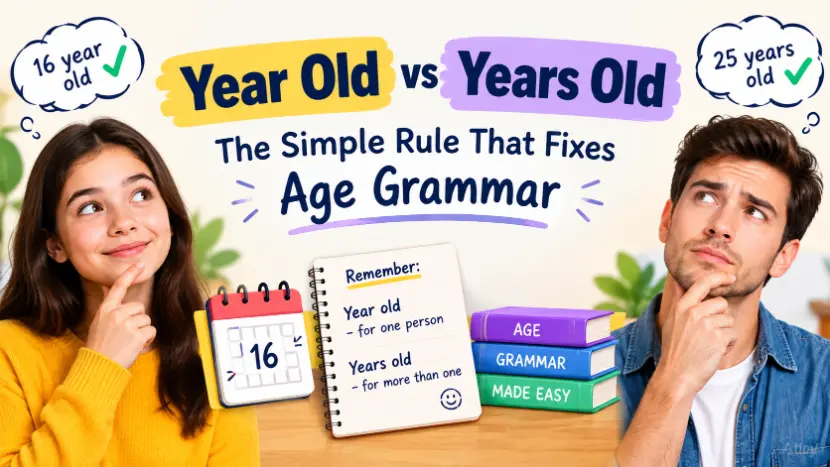
Year old vs years old is one of those grammar questions that looks tiny, but it causes big mistakes. The good news is that the rule is simple once you separate singular age from plural age and understand where the phrase sits in a sentence. In most writing, the choice comes down to whether you are talking about one year or more than one year. The other layer is punctuation, because one-year-old often works as a hyphenated adjective before a noun.
Here’s why this matters. Readers notice age wording fast. If the form looks off, the sentence feels unpolished even when the meaning is clear. That is a problem in formal writing, SEO content, school work, and professional copy. So let’s strip it down and make the rule impossible to miss.
The Core Rule Explained Simply
At the most basic level, year old and years old are used to show age, but the number decides the grammar. Use year with one, and use years with two or more. That is the core pattern.
There is one more detail that matters just as much. When the age phrase comes before a noun, it usually becomes a hyphenated adjective, like a one-year-old child. When it comes after a verb, the hyphen usually disappears, like the child is one year old. That is the part many writers miss.
Look at this:
Category 1: One year old
Use this when the age is exactly one.
Category 2: Years old
Use this when the age is two or more.
Both categories are correct, but they are not interchangeable.
Side-by-Side Comparison Table
| Situation | Correct Form | Example | Why It Works |
| Age is exactly 1 | one year old | The baby is one year old. | Year stays singular because the number is 1. |
| Age is 1 before a noun | one-year-old | She has a one-year-old son. | The phrase acts like an adjective, so it is hyphenated. |
| Age is 2 or more | years old | The dog is three years old. | Years becomes plural because the number is greater than 1. |
| Age is 2 or more before a noun | two-year-old | They adopted a two-year-old kitten. | The whole age phrase modifies the noun. |
The pattern is easy once you see it in action. The number controls the noun. The sentence position controls the hyphen.
Deep Dive into Category 1: One Year Old
When to use one year old
Use one year old when the age is exactly 1 and the phrase follows a verb or linking word. This is the standard form in clean, natural English. It appears in everyday writing, journalism, parenting content, and academic prose.
Examples:
The child is one year old.
My laptop is one year old.
The rescue dog is one year old.
Notice the pattern. The phrase tells you age, but it does not need to sound fancy. It just needs to be accurate. The singular form is non-negotiable when the number is one.
Here’s the practical rule. If you can replace the number with 1, you need year, not years. That is the fastest way to check yourself.
When to use one-year-old
Use one-year-old when the age phrase comes before a noun. In that position, it functions like an adjective. English likes hyphens in that role because they keep the idea together.
Examples:
a one-year-old child
a one-year-old tree
a one-year-old project
The hyphen matters because it makes the phrase read as one unit. Without it, the sentence can look clumsy or ambiguous. That is especially true in edited writing, published content, and formal documents.
Look at this:
The one-year-old child smiled.
The child is one year old.
Same age, different job in the sentence. That is the key distinction.
Quick Test for Category 1
Use this checklist before you publish:
Is the age exactly 1?
Does the phrase come before a noun?
Do you need the phrase to work as an adjective?
If yes, use one-year-old before a noun and one year old after a verb.
That is the entire test. No extra rules are needed.
Deep Dive into Category 2: Years Old
When to use years old
Use years old when the age is 2 or more and the phrase follows a verb or linking word. The plural form matches the number. That is the standard grammar choice.
Examples:
The child is two years old.
The building is twenty years old.
My phone is five years old.
This is the simplest part of the rule. The plural noun years signals more than one unit of time. That keeps the sentence grammatical and easy to read.
Here is the mistake many writers make. They accidentally write 2 year old or three year old after a verb. That is usually wrong. Once the number is above one, years must be plural.
When to use two-year-old, ten-year-old, and similar forms
When the age phrase comes before a noun, it becomes hyphenated again.
Examples:
a two-year-old puppy
a ten-year-old boy
a twenty-year-old policy
This structure works the same way as one-year-old, except the noun changes to years because the quantity is plural. The number itself decides the noun form. The hyphen tells the reader the phrase belongs together.
The pattern is consistent. That is why this rule is reliable in long-form writing, headlines, captions, and academic text.
Pattern to remember
Say the number out loud.
If it is one, use year.
If it is more than one, use years.
If the phrase goes before a noun, add hyphens.
That is the whole system.
The Meaning Shift, or Nuance
The subtle difference is not about age itself. It is about grammar function. When people compare year old vs years old, they are usually really comparing singular vs plural, and sometimes predicate vs attributive use.
For example:
The child is one year old.
A one-year-old child.
Both express the same age. The meaning has not changed. What changes is the sentence role. One version stands after a verb. The other version describes a noun.
That nuance matters because many writers assume the hyphen changes the age. It does not. It changes the structure.
There is also a second nuance. In some casual speech, people skip precision and say things like “my kid is one-year-old” without stopping to think about the sentence role. Spoken English forgives that more easily than edited writing. Written English does not.
So the real shift is this: meaning stays the same, grammar changes.
Why the Confusion Persists
This topic confuses people for a few clear reasons. First, age phrases are common in speech, so many speakers learn them by ear instead of by rule. Spoken English does not always make the hyphen obvious, so the written form feels inconsistent.
Second, online writing spreads mixed examples. One article writes three year old, another writes three-year-old, and a third writes three years old. Without context, readers copy the pattern they saw, even when it was not correct for that sentence.
Third, age phrases often appear in rushed writing. Product descriptions, parenting posts, social captions, and headlines move fast. In fast copy, the writer may remember the number but forget the grammar.
Here’s the root problem. People think the phrase is one fixed chunk. It is not. It changes based on number and sentence position.
That is why the rule feels slippery until you break it into parts.
Formal vs Casual Contexts
In formal writing, accuracy matters more, so the rule should be applied carefully every time. This includes essays, reports, articles, editorial content, legal-adjacent writing, and academic work. In those settings, readers expect one year old and years old to be used cleanly and consistently.
In casual writing, people are more relaxed. Text messages, social posts, and quick comments often ignore hyphens or use shorthand. A reader may still understand the meaning even if the form is loose.
But comprehension is not the same as quality.
If you are writing for a blog, brand, school assignment, or client, follow the formal pattern:
Use one year old after a verb.
Use one-year-old before a noun.
Use years old for two or more after a verb.
Use two-year-old, five-year-old, and similar forms before nouns.
That gives your writing a sharper, more professional finish.
Case Studies and Pop Culture Examples
Let’s make this concrete.
A parenting article might say, “My son is one year old, and he just started walking.” That is a normal predicate structure. Nothing fancy is needed.
A news headline might say, “Three-year-old rescued from floodwaters.” That headline uses the hyphenated adjective because the age phrase comes before the noun. It is compact and easy to scan.
A medical note might say, “Patient is eight years old.” That is direct, formal, and clear. The number is above one, so the plural is correct.
A product review might say, “The two-year-old battery still holds charge.” That sounds natural because the age phrase describes the noun that follows.
Pop culture also uses the same pattern constantly. Entertainment headlines often refer to teenage stars, ten-year-old actors, or one-year-old viral clips. Even when the subject is playful, the grammar remains the same.
The lesson is simple. Different contexts may change the tone, but they do not change the core rule.
Advanced Scenarios and Flowchart
Some sentences are trickier because the age phrase is embedded in a longer structure. The safest move is to identify two things: the number and the sentence role.
Use this decision path:
Start here
Is the phrase talking about age?
Yes
Is the age exactly 1?
Yes
Is the phrase before a noun?
Yes, use one-year-old
No, use one year old
No
Is the age 2 or more?
Yes
Is the phrase before a noun?
Yes, use two-year-old, five-year-old, and similar forms
No, use two years old, five years old, and similar forms
No
Recheck the number, the phrase may not be an age expression
This flowchart works because it checks the only two things that matter. It does not overcomplicate the issue. It also helps when you are editing quickly and do not want to second-guess yourself.
Here are a few advanced examples:
The one-year-old model failed the test.
The model is one year old.
A twenty-year-old treaty was revised.
The treaty is twenty years old.
A one-year-old account can still be active.
The account is one year old.
Each example follows the same pattern. That consistency is what makes the rule dependable.
Quick Reference Table
| Fast Check | Correct Form |
| Age is 1 after a verb | one year old |
| Age is 1 before a noun | one-year-old |
| Age is 2 or more after a verb | two years old, three years old |
| Age is 2 or more before a noun | two-year-old, three-year-old |
| Unsure about the number | Count it first, then choose singular or plural |
This table is the version to bookmark mentally. It compresses the entire rule into one glance.
Common Mistakes That Lower Quality
One common mistake is writing 1 years old. That is incorrect because one takes the singular noun year.
Another mistake is writing one year-old or two years-old with the hyphen in the wrong place. If the phrase modifies a noun, the hyphen belongs inside the full compound, like one-year-old or two-year-old. The noun does not get isolated from the rest of the phrase.
A third mistake is using hyphens where they are not needed after a verb. For example, “The child is one-year-old” is usually not the cleanest form. In that sentence, one year old reads better and matches standard usage.
A fourth mistake is forgetting that years is plural. Writers sometimes copy the singular form everywhere because it sounds familiar. That works only when the age is one.
A fifth mistake is inconsistency inside the same document. One paragraph says three-year-old, another says three year old, and a third says three years old. That makes the piece look careless.
The fix is simple. Check the number. Check the sentence role. Then apply the hyphen only when needed.
Memory Hacks That Actually Work
Use the 1 = year trick. If the age is one, the word stays singular.
Use the more than 1 = years trick. If the age is above one, the noun becomes plural.
Use the before noun = hyphen trick. If the age phrase comes before a noun, connect it with hyphens.
Say it this way in your head:
one year old, but one-year-old child.
five years old, but five-year-old dog.
That contrast is easy to remember because it sounds natural.
Another helpful trick is to rewrite the sentence both ways.
The child is one year old.
A one-year-old child.
If both versions make sense, you have likely placed the hyphen correctly. This works because it forces you to think about grammar role, not just spelling.
Finally, remember that the age phrase behaves like a small machine. The number picks singular or plural. The sentence position picks the hyphen. That is all.
Why Precision Matters, SEO and Authority
Precision in grammar builds trust. When a reader sees correct usage, the writing feels more credible, more careful, and more authoritative. That is true in blogs, newsletters, educational content, and brand pages.
It also matters for SEO. Search engines reward content that is readable, useful, and well structured. Clean grammar helps the page feel professional, and professional content tends to keep readers engaged longer. That can improve user satisfaction, which is a strong signal for content quality.
More importantly, precision reduces friction. If a reader has to pause and wonder whether 2 year old should be 2-year-old or 2 years old, the flow breaks. Strong writing removes that pause.
This is why small grammar details matter. They make your content easier to trust, easier to scan, and easier to remember.
In a crowded search landscape, credibility is an advantage. Correct age phrasing is a small signal, but small signals add up.
Quick Quiz
Fill in the blanks with the correct form.
- The baby is ____ ____ ____ old.
- A –-____ child was sleeping in the stroller.
- The house is ____ years old.
- She adopted a –-____ puppy.
- My brother is ____ year old.
- The school is ____ years old.
- We read about a –-____ actor in the news.
Answer key:
- one year
- one-year-old
- ten
- three-year-old
- one
- five
- twelve-year-old
The quiz works best if you say each answer aloud. That helps you hear the singular and plural shift.
Year old vs years old becomes easy once you stop treating it like a memorization problem. It is really a number rule, plus a sentence-position rule. Keep one year old for age after a verb, use one-year-old before a noun, and switch to years old whenever the number is above one. After a little practice, the pattern becomes automatic.
Conclusion
Mastering year old vs years old is much easier than it first appears because the rule follows a logical pattern. If the age is one, use year. If the age is two or more, use years. Then, decide whether the age phrase comes before a noun or after a verb. Before a noun, the phrase becomes a hyphenated compound adjective, such as one-year-old or five-year-old. After a verb, write it without hyphens, as in one year old or five years old. Once you recognize these two simple decisions, you can avoid the most common grammar mistakes and write with greater confidence in every situation.
Correct age expressions improve more than grammar, they improve readability, professionalism, and credibility. Whether you’re creating SEO content, writing academic papers, preparing business documents, or posting on social media, using the correct form shows attention to detail and strengthens your communication. Readers rarely notice perfect grammar, but they often notice errors that interrupt the flow of a sentence. By applying the straightforward rules covered in this guide and practicing with real examples, you’ll naturally choose the correct form every time. Small grammar improvements like these make your writing clearer, more authoritative, and easier for both readers and search engines to understand.
Frequently Asked Questions
Is “one years old” ever grammatically correct?
No, one years old is grammatically incorrect because the number one always takes the singular noun year. The correct expression is one year old. Whether you’re speaking or writing, using the singular form after the number one is a standard rule in English grammar that should always be followed.
Should I write “two year old” or “two-year-old”?
It depends on the sentence. If the phrase comes before a noun, write two-year-old, as in a two-year-old child. If it appears after a verb, write two years old, as in the child is two years old. The sentence structure determines whether hyphens are needed.
Why are hyphens used in age expressions?
Hyphens connect multiple words into a single adjective when they describe a noun. For example, five-year-old student uses hyphens because the entire phrase modifies student. Without hyphens, the sentence can become harder to read and may appear grammatically incorrect in formal writing.
Is “year old” always singular?
No. Year remains singular only when the age is exactly one. For any age greater than one, the correct plural form is years, such as three years old or twelve years old. The number always determines whether the noun is singular or plural.
Can I omit the hyphens in casual writing?
Many people omit hyphens in informal messages or social media posts, but doing so is not considered standard grammar. In professional, academic, journalistic, or SEO writing, you should use hyphens correctly whenever the age phrase appears before a noun to maintain clarity and consistency.
Do these grammar rules apply to objects and animals too?
Yes. The same rules apply whether you’re describing people, animals, buildings, vehicles, products, or anything else with an age. For example, a ten-year-old tree and the tree is ten years old both follow exactly the same grammatical pattern as age expressions for people.
Does British English use different rules?
No. Both American and British English follow the same core grammar rules for year old and years old. Minor style guide differences may exist in punctuation preferences, but singular versus plural usage and compound adjective rules remain consistent across both varieties of English.
Why do so many websites use incorrect age expressions?
Many online articles are written quickly or copied from other sources without careful editing. As a result, incorrect phrases such as three year old often spread across the internet. Relying on established grammar rules rather than copying examples from random websites will help you write more accurately.
What is the easiest way to remember the correct form?
A simple memory trick is to ask two questions. First, is the age one or more than one? Second, is the phrase before a noun or after a verb? The first answer tells you whether to use year or years, while the second tells you whether hyphens are needed.

Noor Sullivan is a passionate writer and English enthusiast dedicated to making language easier to understand and use. At GrammarFixery, Noor creates clear, practical content covering grammar, vocabulary, word meanings, sentence structure, and everyday English. With a friendly and straightforward approach, Noor helps readers turn confusing language questions into useful answers. Whether you are a student, professional, writer, or English learner, Noor’s guides are designed to build confidence, improve writing, and make communicating ideas feel natural and effortless.