
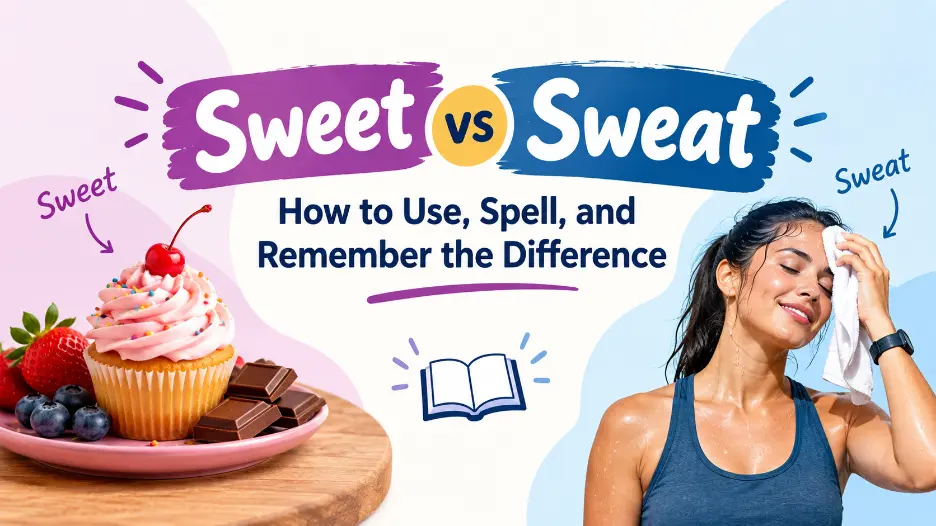
Sweet vs sweat is a tiny spelling pair with a big impact. One letter changes the word, the meaning, and the impression you make on the reader. Sweet can describe taste, kindness, or something pleasant. Sweat refers to the moisture your body produces, or the act of sweating.
Here is the real issue, people hear these words often, but the spelling sounds close enough to cause mistakes. That is why sweet vs sweat shows up in searches, schoolwork, captions, emails, and everyday writing. Once you learn the core rule, the difference becomes easy to spot. The trick is to slow down just enough to notice what the sentence is really talking about.
The Core Rule Explained Simply: Strip the concept down to its absolute basics.
At the simplest level, sweet and sweat are not interchangeable. They are separate words with separate meanings, and they belong in different situations. Sweet usually points to something pleasant, sugary, affectionate, or charming. Sweat points to perspiration, effort, heat, anxiety, or physical exertion.
The fastest way to separate them is this, ask yourself whether the sentence is about taste or kindness. If yes, the word is usually sweet. Ask yourself whether the sentence is about body moisture or hard work. If yes, the word is usually sweat. That simple split solves most mistakes before they happen.
Side 1: Sweet means pleasant, sugary, or kind.
Sweet is the word you use for flavor, personality, tone, or something enjoyable. A sweet drink tastes sugary. A sweet gesture feels thoughtful. A sweet deal sounds attractive or favorable. The word can even describe a calm, satisfying outcome, like a sweet victory.
Side 2: Sweat means perspiration or effort.
Sweat is the word you use when the body gets hot, nervous, or active. You sweat during a workout, on a summer day, or when you are anxious. It can also work as a verb in phrases like “to sweat over a project,” meaning to work hard on it. In that sense, sweat can describe both literal moisture and intense effort.
Side-by-Side Comparison Table: Create a 4-column table comparing aspects of the topic
| Situation | Example | Meaning | Correct Usage |
| Taste | The cake is sweet | Sugary flavor | Use sweet |
| Personality | She gave a sweet smile | Kind or charming | Use sweet |
| Body response | He started to sweat in the heat | Perspiration | Use sweat |
| Stress or effort | They sweat over the final draft | Work hard or worry | Use sweat |
| Compliment | That was a sweet message | Pleasant or thoughtful | Use sweet |
| Gym context | I was sweating after the run | Physical exertion | Use sweat |
Deep Dive into Category 1: Sweet
When to use sweet
Use sweet when the idea is pleasant, sugary, affectionate, or appealing. It often shows up in food descriptions, compliments, and emotional language. You may also use it in informal praise when something feels cool or impressive. In modern speech, people sometimes say “That is sweet” to mean “That is really nice.”
Look at this, the word works in both literal and figurative contexts. A sweet apple literally tastes sugary. A sweet memory feels emotionally pleasant. A sweet offer suggests something appealing or favorable. The meaning stays positive, even if the exact situation changes.
Common patterns with sweet
You will often see sweet with nouns related to flavor and feeling. Common combinations include sweet candy, sweet tea, sweet voice, sweet gesture, and sweet reward. It can also describe people, especially in friendly or affectionate language. For example, “She is so sweet” means she is kind, thoughtful, or gentle.
The word also appears in idioms and casual praise. “Sweet!” is a quick expression of approval. “That is pretty sweet” means something is impressive, attractive, or enjoyable. In these examples, sweet does not mean sugar exactly, it means something positive and pleasing.
Examples of sweet in real sentences
The dessert tasted sweet and rich.
That was a sweet thing to do for your friend.
He has a sweet voice that makes people feel calm.
We found a sweet spot near the front of the stage.
She got a sweet new job offer.
Quick Test for sweet
Use this checklist before choosing sweet:
Is the sentence about taste, kindness, or pleasantness?
Could the word be replaced with “pleasant,” “kind,” or “sugary”?
Does the tone feel positive instead of physical?
If the answer is yes, sweet is probably correct.
Deep Dive into Category 2: Sweat
When to use sweat
Use sweat when you mean perspiration, physical exertion, or anxious effort. This is the word for what happens when your body gets hot, stressed, or active. It is also the right choice in phrases about hard work, like sweating through a deadline or sweating over an exam. The core idea is strain, heat, or pressure.
Here is why it matters, sweat is often the more literal word in health and fitness contexts. People sweat during workouts, in humid weather, or when they are nervous. Writers also use it figuratively to show mental pressure. For example, “He sweated over every detail” means he worked intensely and worried a lot.
Common patterns with sweat
You will often see sweat with body language, weather, sports, and deadlines. Common combinations include sweat gland, sweat stains, sweat shirt, sweat it out, and break a sweat. It can function as a noun or a verb, which adds to the confusion. As a noun, it names the moisture itself. As a verb, it describes the act of producing it.
The phrase “No sweat” is especially common in casual English. It means “No problem” or “That was easy.” This usage is idiomatic, so it does not always connect directly to body moisture. Still, the spelling remains sweat, not sweet.
Examples of sweat in real sentences
I could feel the sweat on my forehead after the hike.
She began to sweat when the room got too warm.
He sweated through the last mile of the race.
Do not sweat the small stuff.
The coach made us sweat during practice.
Quick Test for sweat
Use this checklist before choosing sweat:
Is the sentence about heat, exercise, anxiety, or effort?
Could you replace the word with “perspire” or “work hard”?
Does the sentence describe something physical or stressful?
If the answer is yes, sweat is likely the right word.
The Meaning Shift (or Nuance): Explain the subtle differences between the options.
The difference between sweet and sweat is not just spelling, it is meaning. Sweet is associated with pleasure, comfort, and positive emotion. Sweat is associated with physical response, pressure, and exertion. That difference can feel subtle because both words can appear in casual speech and informal writing.
The nuance becomes clearer when you look at tone. Sweet usually softens a sentence. It gives warmth, friendliness, or approval. Sweat usually makes a sentence feel active, tense, or physical. One word leans toward comfort. The other leans toward strain.
There is also a pronunciation detail that helps. Sweet has a long ee sound. Sweat has a short e sound. Many spelling mistakes happen because readers rely on sound alone. Since the sounds are close, the eye has to do more work than the ear.
Why the Confusion Persists: Explain the core problem, education gaps, or evolving trends.
This confusion lasts because the two words are close in sound, close in rhythm, and common in everyday speech. Many speakers hear them long before they learn to spell them confidently. That means the brain stores the sound first, not the spelling pattern. When someone writes quickly, the wrong form can slip in easily.
Another reason is that both words show up in informal communication. Text messages, comments, and captions often move fast, so people do not pause to check spelling. In those settings, the error may be overlooked, which makes it feel less serious than it really is. Over time, that can weaken spelling accuracy.
There is also a pattern problem. English uses many one-letter differences to separate unrelated words. That makes the language efficient, but it also makes it tricky. Sweet vs sweat is a perfect example of how a single vowel can change meaning completely.
Formal vs Casual Contexts: Explain how usage changes depending on the environment.
In formal writing, spelling accuracy matters more because readers expect precision. In essays, business emails, academic work, and published content, mixing up sweet and sweat can look careless. Even if the rest of the writing is strong, a simple spelling error can distract the reader and weaken credibility.
In casual writing, the tone is more relaxed, but the distinction still matters. A text message saying “That is sweet” and one saying “I am sweating” create very different impressions. The words may appear in jokes, slang, or quick replies, but the core meanings stay the same. Context does most of the work, yet correct spelling still helps the message land cleanly.
One useful rule is this, the more public the writing, the more important the spelling. A private text might survive a mistake. A blog post, article, or professional document should not. That is why mastering sweet vs sweat is useful even for everyday writers.
Case Studies / Pop Culture Examples: Provide real-world, academic, or cultural examples.
In pop culture, sweet is often used as a compliment. People say “That is sweet” after hearing good news, seeing a kind gesture, or reacting to something exciting. The word carries warmth and approval, so it works well in dialogue and captions. It is short, flexible, and friendly.
In fitness culture, sweat is a badge of effort. People talk about breaking a sweat, sweating it out, or earning the sweat after a tough workout. The word gives a vivid physical image. It tells the reader that work happened, and it happened intensely.
In academic writing, the distinction appears in language lessons, vocabulary tests, and proofreading exercises. Teachers use pairs like sweet vs sweat because they train students to notice minimal spelling differences. That kind of practice improves editing skills and strengthens word recognition. It is a small example, but it has a big payoff.
Look at social media too. A caption like “Feeling sweet after this coffee” suggests something pleasant. A caption like “Sweating through Monday” suggests stress or effort. The same writer could use both words in the same week, but the meanings stay separate and clear.
Advanced Scenarios & Flowchart: Provide a text-based decision flowchart to help the reader decide.
When the sentence is not obvious, use a decision path.
Start here:
Is the sentence about taste, kindness, charm, or something pleasant?
If yes, choose sweet.
If no, move to the next question.
Is the sentence about body heat, perspiration, exercise, stress, or hard effort?
If yes, choose sweat.
If no, move to the next question.
Are you using a casual expression like “That is sweet” to show approval?
If yes, choose sweet.
If no, move to the next question.
Are you describing a phrase like “sweat it out,” “break a sweat,” or “no sweat”?
If yes, choose sweat.
If no, check the meaning again.
Can the sentence be reworded with “nice,” “kind,” or “sugary”?
If yes, sweet is usually correct.
Can the sentence be reworded with “perspire,” “worry,” or “work hard”?
If yes, sweat is usually correct.
This flowchart works because it forces meaning before spelling. That is the safest habit. Writers often guess first and think later. A quick meaning check prevents those mistakes.
Quick Reference Table: A simple 2-column summary table for fast checking.
| Word | Fast Reminder |
| Sweet | Pleasant, sugary, kind, charming, appealing |
| Sweat | Perspiration, heat, stress, effort, workout |
Common Mistakes That Lower Quality: List what even experienced people get wrong.
The most common mistake is choosing the word based on sound alone. Since sweet and sweat sound close, people may type the first one that comes to mind. That habit produces errors in fast writing, especially on phones.
Another mistake is using sweet when the meaning is physical. A sentence about a person being hot after exercise should almost always use sweat, not sweet. The reverse happens too. Writers sometimes use sweat when they mean something pleasant or charming. That weakens the sentence and makes it confusing.
A third mistake is ignoring the phrase structure. Expressions like no sweat and sweat it out are fixed patterns. You cannot swap in sweet just because it looks similar. Idioms are especially unforgiving because the wrong word changes the phrase completely.
A fourth mistake is not proofreading in context. A sentence can look fine in isolation, but the meaning can still be off. Good writers read the sentence aloud, ask what it means, and then verify the spelling. That small habit catches a lot of avoidable errors.
Memory Hacks That Actually Work: Actionable tricks to remember the rules.
Use the ee trick for sweet. The double e can remind you of easy, gentle, pleasant, and pleasant feelings. If the idea is nice or sugary, think of the extra vowels stretching out the word.
Use the weat warning for sweat. The word contains weat, which can remind you of warmth, work, and worry. That is a good fit because sweat appears when the body is warm or when the mind is under pressure. The spelling looks a little sharp, just like the physical feeling.
Another trick is to pair each word with a picture. For sweet, imagine candy or a kind smile. For sweat, imagine a runner after a sprint. Visual memory often sticks better than abstract rules.
You can also use sentence swaps. Replace the word with “kind” or “sugary.” If the sentence still works, sweet is probably right. Replace it with “perspire” or “strain.” If that fits, sweat is the better choice. This is one of the most reliable checks for everyday writing.
Why Precision Matters (SEO/Authority): Explain why getting this right builds credibility.
Precision builds trust. When readers see correct spelling, they feel more confident in the writer’s ability to handle language carefully. That matters in blog posts, educational content, marketing copy, and authority pages. A small word choice can influence how polished the entire piece feels.
For SEO, precision also helps readability. Search engines do not reward sloppy writing. Clear, accurate content improves user experience, which supports stronger engagement. When a reader searches for sweet vs sweat, they are usually looking for a fast, trustworthy answer. If your article explains the difference clearly, it is more likely to satisfy that intent.
This is especially important in competitive content. A page that handles small details well tends to feel more useful than one that rushes through them. Accurate use of sweet and sweat signals competence. Competence keeps readers on the page.
A quick quiz: 5 to 8 fill in the blanks.
- That dessert tastes very ________.
- She gave me a ________ compliment.
- After the hike, I started to ________.
- Do not ________ the small stuff.
- The puppy was so ________ and friendly.
- He could feel the ________ on his neck during the race.
- That was a ________ deal for the price.
- The team had to ________ through the final minute of the game.
Answer key: 1. sweet 2. sweet 3. sweat 4. sweat 5. sweet 6. sweat 7. sweet 8. sweat
Conclusion
Understanding sweet vs sweat is much easier once you focus on the meaning instead of the spelling. Sweet belongs in conversations about pleasant tastes, kind people, thoughtful actions, or anything enjoyable. Sweat, on the other hand, belongs in situations involving perspiration, physical activity, stress, or hard work. Although these words differ by just one letter, they communicate completely different ideas. Taking a moment to identify the context before writing can eliminate one of the most common spelling mistakes in English. Whether you are writing an email, a school assignment, a blog post, or a social media caption, using the correct word makes your writing clearer, more professional, and easier for readers to trust.
The best way to master sweet vs sweat is through regular practice and careful proofreading. Read your sentence aloud, identify what it is describing, and then match the word to its correct meaning. If the sentence is about something pleasant, sugary, or kind, choose sweet. If it involves exercise, heat, effort, or perspiration, choose sweat. Small spelling decisions have a surprisingly large impact on readability and credibility, especially in professional or academic writing. Once you develop the habit of checking meaning first, you will rarely confuse these words again, and your writing will become more polished, accurate, and authoritative.
FAQs
What is the main difference between sweet and sweat?
The primary difference is their meaning. Sweet describes something pleasant, sugary, kind, affectionate, or enjoyable. Sweat refers to the moisture your body produces during heat or physical activity, or the act of perspiring. Even though they sound somewhat similar, they are unrelated words and should never be used interchangeably.
Is sweet a noun, adjective, or adverb?
Sweet is most commonly used as an adjective because it describes nouns, such as sweet fruit, sweet voice, or sweet gesture. It can also function as a noun in limited contexts, such as referring to candy or desserts collectively. However, in everyday writing, it is usually an adjective describing something pleasant or sugary.
Can sweat be both a noun and a verb?
Yes. Sweat works as both a noun and a verb. As a noun, it refers to perspiration produced by the body. As a verb, it means to produce perspiration or to work hard under pressure. Understanding its grammatical role helps you use it correctly in different sentence structures.
Why do people confuse sweet and sweat?
People often confuse these words because they look similar and have somewhat similar pronunciations. Many English learners remember how words sound before learning their correct spelling. Fast typing, autocorrect mistakes, and limited proofreading also contribute to this common spelling error in everyday writing.
How can I quickly remember which word to use?
Think about the meaning first. If the sentence is about flavor, kindness, or something pleasant, use sweet. If it involves exercise, heat, stress, or perspiration, use sweat. Associating sweet with desserts and sweat with workouts creates a simple mental shortcut that is easy to remember.
Is no sweat the correct expression?
Yes, no sweat is the correct expression. It is an informal phrase that means “no problem” or “it was easy.” Even though the expression does not literally refer to perspiration in most situations, the established spelling is always sweat, never sweet.
Can sweet describe people?
Absolutely. Sweet is commonly used to describe someone who is kind, caring, thoughtful, or gentle. Saying that a person is sweet is considered a compliment because it highlights their positive personality rather than anything related to physical appearance or ability.
Does using the wrong word affect professional writing?
Yes. Confusing sweet and sweat can reduce the credibility of your writing. Readers may see the mistake as a lack of attention to detail, especially in business documents, academic papers, marketing content, or professional emails. Correct spelling improves clarity and builds trust with your audience.
Are sweet and sweat pronounced the same?
No. They are pronounced differently, although they sound similar enough to confuse many writers. Sweet uses a long ee vowel sound, while sweat uses a shorter e sound. Listening carefully to the vowel sound and connecting it with the word’s meaning can improve both spelling and pronunciation.
How can I stop making this mistake permanently?
The most effective strategy is to proofread with meaning in mind instead of relying on sound alone. Before finalizing your writing, ask yourself whether the sentence is describing something pleasant or something involving effort and perspiration. Repeating this habit consistently strengthens word recognition and makes choosing the correct spelling almost automatic.

Noor Sullivan is a passionate writer and English enthusiast dedicated to making language easier to understand and use. At GrammarFixery, Noor creates clear, practical content covering grammar, vocabulary, word meanings, sentence structure, and everyday English. With a friendly and straightforward approach, Noor helps readers turn confusing language questions into useful answers. Whether you are a student, professional, writer, or English learner, Noor’s guides are designed to build confidence, improve writing, and make communicating ideas feel natural and effortless.