
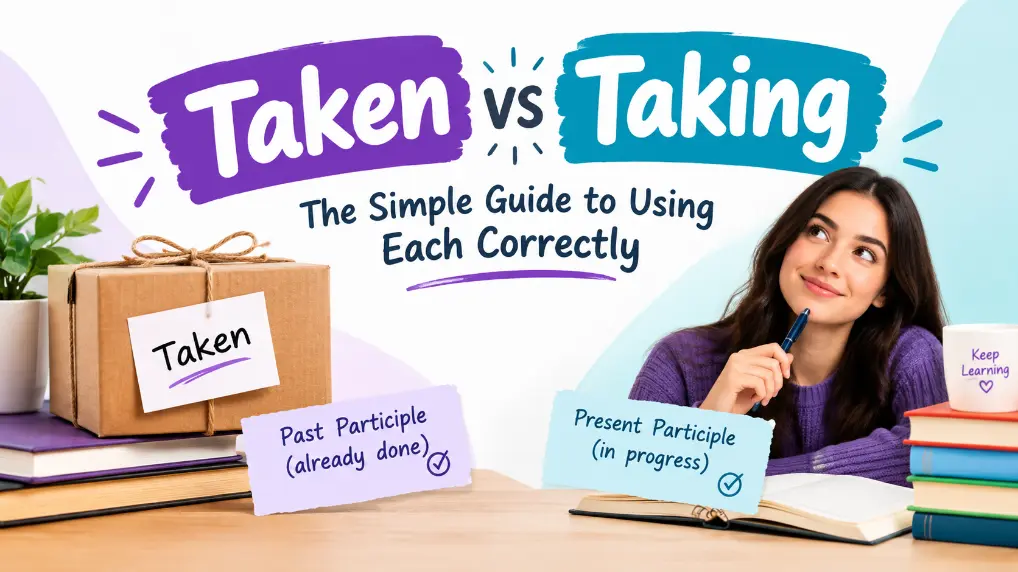
Taken vs taking confuses a lot of English learners because both words come from the same verb, take, yet they do very different jobs. One usually shows a completed action, while the other points to an ongoing action. That sounds simple, but in real sentences the difference can hide inside tense, grammar structure, and even tone.
Here is the key idea: taken is the past participle, and taking is the present participle. In everyday English, that means taken often appears with helper verbs like has, have, had, or was, while taking often appears with is, are, was, were, or it can work as a gerund or adjective. Once you understand the pattern, the confusion drops fast.
The Core Rule Explained Simply
At the most basic level, this is about finished action versus action in progress. Taken usually signals that something has already been done, completed, or accepted. Taking usually signals that something is happening now, or happening over a stretch of time.
Think of it this way, taken answers the question, “What has already happened?” Taking answers the question, “What is happening now?” That one shift changes the grammar, the timing, and the meaning of the sentence.
The first side, taken
Taken is the form you use when the action is complete or when you need the past participle form of take. It appears in perfect tenses, passive voice, and fixed expressions. It often sounds more finished, more official, and more settled.
The second side, taking
Taking is the form you use when the action is still going on or when take is acting like a noun or descriptive word. It can describe movement, behavior, or a process that has not ended yet. It feels more active, more immediate, and often more visual.
Side-by-Side Comparison Table
| Situation | Example | Meaning | Correct Usage |
| Completed action | She has taken the exam. | The exam is finished. | Use taken |
| Action in progress | She is taking the exam. | The exam is happening now. | Use taking |
| Passive structure | The book was taken from the shelf. | Someone removed it. | Use taken |
| Ongoing activity | He is taking notes. | He is writing notes right now. | Use taking |
Deep Dive into Category 1: Taken
When to use taken
Use taken when the action of take is complete or when the sentence needs the past participle form. This is the form that works with perfect tenses and passive voice. It also appears in expressions like taken advantage of, taken into account, and taken for granted.
Look at this pattern.
has/have/had + taken
That structure almost always shows completion.
Examples:
- She has taken the medicine.
- They had taken the wrong road.
- The decision was taken after the meeting.
- I have taken your advice seriously.
In each one, the idea is not “currently taking.” The action is already done, established, or completed.
What taken looks like in real sentences
Taken often shows up in formal writing, reports, business communication, and academic English. It can also appear in idioms, which makes it extra important for fluent writing. Some learners know the word, but they miss its many fixed uses.
Examples:
- The manager has taken responsibility for the delay.
- His comments were taken out of context.
- The photo was taken at sunset.
- The offer has taken effect.
Notice how the sentence feels finished. The event, decision, or action is no longer unfolding. It is done.
Quick Test for taken
Ask yourself these questions:
- Is the action already completed?
- Is there a helper verb like has, have, had, or was?
- Does the sentence sound like a result, not a process?
- Would replacing it with taking make the sentence sound unfinished?
If the answer is yes to the first three, taken is probably right.
Common taken patterns
Here are the most common forms:
- has taken
- have taken
- had taken
- was taken
- were taken
- taken by
- taken from
- taken into account
These patterns matter because they show that taken is not acting alone. It usually needs grammar support.
Deep Dive into Category 2: Taking
When to use taking
Use taking when the action is in progress, repeated, or functioning as a noun or adjective. It belongs to continuous tenses, so you will often see it with am, is, are, was, or were. It can also appear in noun-like structures.
Examples:
- She is taking a break.
- They are taking the train.
- He was taking notes during the lecture.
- I enjoy taking photos.
In each case, the action is active. It is not completed. It is happening now or being treated as an activity.
What taking looks like in real sentences
Taking often feels more dynamic because it paints the action as ongoing. It is useful for describing behavior, temporary states, or current progress. It can also appear in phrases like taking care of, taking part in, and taking place.
Examples:
- She is taking care of her younger brother.
- The meeting is taking place online.
- They are taking part in the competition.
- He keeps taking long pauses before answering.
Here, the meaning is process, not completion. That is the main difference.
Quick Test for taking
Ask yourself these questions:
- Is the action happening right now?
- Does the sentence include a continuous verb like is taking or are taking?
- Is taking functioning like an activity, habit, or ongoing process?
- Would taken make the sentence sound too finished?
If yes, taking is likely the correct choice.
Common taking patterns
Some of the most common structures include:
- is taking
- are taking
- was taking
- were taking
- taking notes
- taking action
- taking place
- taking care of
These patterns are helpful because they show that taking is often about movement, activity, and continuity.
The Meaning Shift, or Nuance
The subtle difference is not just grammar, it is time and focus. Taken puts the spotlight on the result. Taking puts the spotlight on the action itself.
Consider these two sentences:
- She has taken the job.
- She is taking the job.
The first means she accepted it, and the decision is complete. The second is usually not standard in this exact form unless context changes, because it sounds like the process is happening now, not that the job has been accepted. That is the nuance. The form changes the timeline, and the timeline changes the meaning.
Here is another pair:
- He has taken the keys.
- He is taking the keys.
The first says the keys are already in his possession. The second suggests he is in the act of picking them up right now. Same verb. Different moment. Very different effect.
Why the Confusion Persists
The confusion persists because English uses take in many forms, and learners often see taken and taking in the same sentence family. The spelling is close, the root is the same, and both forms can appear in advanced expressions. That creates a mental shortcut problem.
There is another reason. In real English, tense is not always taught as a clean chart. People hear phrases like taken care of, taking place, taken for granted, and taking notes long before they fully understand participles. So the forms become familiar before the rules do.
Education gaps also matter. Many learners memorize verb forms, but they do not practice the sentence patterns around them. Once those helper verbs and structures are missing, taken and taking start to look interchangeable, even though they are not.
Formal vs Casual Contexts
In formal writing, the difference matters more because readers expect precise tense control. Reports, essays, resumes, business emails, and academic writing all rely on correct verb forms. A wrong choice can make the sentence feel careless or unclear.
Examples in formal style:
- The committee has taken action.
- The proposal is taking shape.
- The evidence was taken into consideration.
- The process is taking longer than expected.
In casual speech, people sometimes speak faster and rely on context. Native speakers may not explain the grammar, but they still use the right form most of the time. The listener fills in the meaning from the situation.
Examples in casual style:
- I’ve taken a nap.
- I’m taking a shower.
- We’re taking the kids to school.
- He’s taken my seat.
So the rule does not change, but the pressure to notice it changes. Formal writing exposes mistakes faster.
Case Studies / Pop Culture Examples
Let’s make this concrete.
In school settings, you might hear: I am taking a test. That means the test is happening now. But after the test ends, you would say: I have taken the test. Same event, different stage. The first is live action. The second is completed action.
In media and entertainment, titles and dialogue often use taking to create motion. Phrases like taking flight, taking charge, or taking the lead feel active and immediate. Meanwhile, taken is often used when the story shifts to consequence, such as taken hostage, taken over, or taken seriously.
A cultural example is the movie title Taken. The word works because it suggests a completed act of abduction or seizure. The title would not have the same punch as Taking, because taking would feel incomplete and ongoing. The choice of form changes the emotional impact.
In academic writing, taken into account is common because it signals careful consideration. In conversation, people may say I’m taking notes because the action is happening live. Both are correct, but they do very different jobs.
Advanced Scenarios & Flowchart
Some sentences get tricky because take is part of a phrase, not just a simple action. Here is a text-based flowchart to help you decide.
Start here:
Is the action complete?
If yes, use taken.
If no, go to the next step.
Is the sentence in a continuous form like is/are/was/were?
If yes, use taking.
If no, go to the next step.
Is take part of a fixed expression like taken into account or taking place?
If yes, use the expression as established.
If no, go to the next step.
Are you talking about a result, decision, or finished event?
If yes, use taken.
If you are describing an activity, process, or motion, use taking.
Here are a few advanced examples:
- The complaint has taken priority.
- The project is taking longer than expected.
- Her work was taken seriously.
- The event is taking place downtown.
When the sentence feels uncertain, ask whether you are describing a state after action or the action itself. That question usually solves it.
Quick Reference Table
| Word | Fast meaning |
| taken | Completed action, past participle, result |
| taking | Ongoing action, continuous form, activity |
Common Mistakes That Lower Quality
One common mistake is using taken when the sentence needs an ongoing action. For example, She is taken notes is incorrect. The right form is She is taking notes.
Another mistake is using taking when the sentence needs completion. For example, He has taking the medicine is incorrect. The correct form is He has taken the medicine.
A third mistake is forgetting helper verbs. Taken rarely stands alone in standard grammar when you mean tense. It usually needs a support verb like has or was. Without that support, the sentence may sound broken.
Another problem is overgeneralizing from phrases. Learners memorize taking place and then try to force taking into every sentence. But not every sentence is about an ongoing process. Grammar still decides.
Finally, people sometimes confuse passive voice with continuous voice. The phone was taken means someone removed the phone. The phone was taking does not work in the same way. That distinction matters in serious writing.
Memory Hacks That Actually Work
Use this shortcut: taken = done. If the action is over, lean toward taken. It is the cleaner memory hook.
Use this second shortcut: taking = happening. If the action is in motion, lean toward taking. The word itself feels like movement, which helps memory.
Here is a stronger trick. Picture taken as the end result in your hand. Picture taking as the hand reaching out. One shows possession or completion. The other shows process.
Another helpful method is the helper verb test:
- has/have/had usually pairs with taken
- is/are/was/were usually pairs with taking
Say it out loud a few times. The rhythm helps the pattern stick.
You can also build memory from common phrases:
- taken advantage of
- taken into account
- taking notes
- taking part in
These phrases train your brain to recognize the difference automatically.
Why Precision Matters, SEO/Authority
Precision matters because grammar shapes trust. When a writer uses taken vs taking correctly, the sentence feels controlled, polished, and professional. That helps the reader focus on the message instead of the mistake.
In SEO content, precision also improves authority. Clear grammar reduces friction, and friction hurts engagement. If readers have to stop and decode simple errors, they are less likely to trust the content or keep reading.
Search engines may not “reward” one verb form by itself, but readers absolutely respond to clarity. Strong grammar supports better readability, stronger retention, and a more credible brand voice. In short, precise language is part of content quality.
This is especially important in educational, legal, business, and health-related content. Those topics depend on confidence. A small tense error can make the whole page feel less reliable.
A quick quiz
Fill in the blanks with taken or taking.
- She has ______ the afternoon off.
- They are ______ a new route to school.
- The photo was ______ during the ceremony.
- I am ______ my time with this decision.
- He had ______ the wrong book home.
- The meeting is ______ place online.
- We have ______ your feedback seriously.
Answers:
- taken
- taking
- taken
- taking
- taken
- taking
- taken
The easiest way to remember taken vs taking is to ask one simple question, is the action finished or in progress? If it is finished, taken is usually the answer. If it is happening now or unfolding, taking is usually the right choice. Once you train your eye to spot the helper verb and the timeline, the difference becomes much easier to use with confidence.
Conclusion
Mastering taken vs taking is less about memorizing definitions and more about understanding when an action is complete versus when it is still happening. Once you recognize that taken is the past participle and taking is the present participle, choosing the correct form becomes much easier. Pay close attention to the helper verbs surrounding each word, because they usually reveal the correct answer. Reading well-written English, practicing with real-life examples, and reviewing common expressions like taken into account or taking place will help reinforce the pattern until it becomes second nature.
Accurate grammar does more than prevent mistakes, it improves clarity, professionalism, and credibility. Whether you’re writing an academic paper, publishing SEO content, sending a business email, or simply having a conversation, using taken and taking correctly makes your message easier to understand. Small grammar improvements often create a big impact on how others perceive your writing. By applying the rules, practicing consistently, and using the quick tests and memory tricks from this guide, you’ll confidently choose the correct word every time and avoid one of the most common English grammar mistakes.
Frequently Asked Questions
Is taken always used with helper verbs?
Not always, but it usually appears with helper verbs such as has, have, had, was, or were because it is the past participle of take. It can also appear as part of adjective-like expressions, such as “I’m taken” or in fixed phrases like taken for granted, where the helper verb may already be understood from the sentence structure.
Can taking be used as a noun?
Yes. Taking can function as a gerund, which is a verb ending in -ing that acts as a noun. For example, in the sentence, “Taking notes improves memory,” the word taking is the subject of the sentence. Although it comes from a verb, it behaves like a noun in this context.
What is the biggest difference between taken and taking?
The main difference is time and function. Taken refers to a completed action or serves as the past participle, while taking refers to an action that is happening now or acts as a gerund. Understanding whether the action is finished or ongoing will usually help you select the correct form.
Why do English learners confuse taken and taking?
Many learners confuse these words because they both come from the verb take and look similar. In addition, English uses many verb forms, continuous tenses, perfect tenses, and fixed expressions that make the distinction less obvious. Learning sentence patterns instead of isolated words makes the difference much easier to remember.
Is has taking ever correct?
No. The phrase has taking is grammatically incorrect in standard English. After has, have, or had, you must use the past participle, which is taken. The correct sentence is “She has taken the class,” not “She has taking the class.”
When should I use is taking?
Use is taking when describing an action that is happening right now or around the current period. For example, “She is taking driving lessons” means the lessons are currently in progress. This structure belongs to the present continuous tense, which emphasizes ongoing activity.
Are there common expressions that always use taken?
Yes. Several fixed expressions always use taken, including taken into account, taken seriously, taken advantage of, taken for granted, and taken by surprise. Because these are established English expressions, it’s helpful to memorize them as complete phrases rather than translating them word by word.
How can I quickly decide whether to use taken or taking?
A simple strategy is to ask whether the action is finished or still happening. If it is complete, taken is usually correct. If the action is ongoing, repeated, or currently happening, taking is usually the right choice. Looking for helper verbs such as has or is can also provide a strong clue.
Does using the correct form improve my writing?
Absolutely. Choosing the correct form improves grammar accuracy, readability, and credibility. Whether you’re writing blog posts, school assignments, business documents, or social media content, correct verb forms make your writing sound more natural and professional. They also help readers understand your meaning without confusion.

Ethan Lawson is a dedicated writer and English enthusiast who enjoys making language simple, practical, and easy to understand. At GrammarFixery, Ethan shares useful guidance on grammar, vocabulary, sentence structure, word meanings, and everyday English. His goal is to help readers write with greater clarity and confidence without making language feel complicated. Whether you are a student, professional, content creator, or English learner, Ethan provides clear tips and helpful examples to make every sentence stronger and easier to understand.