
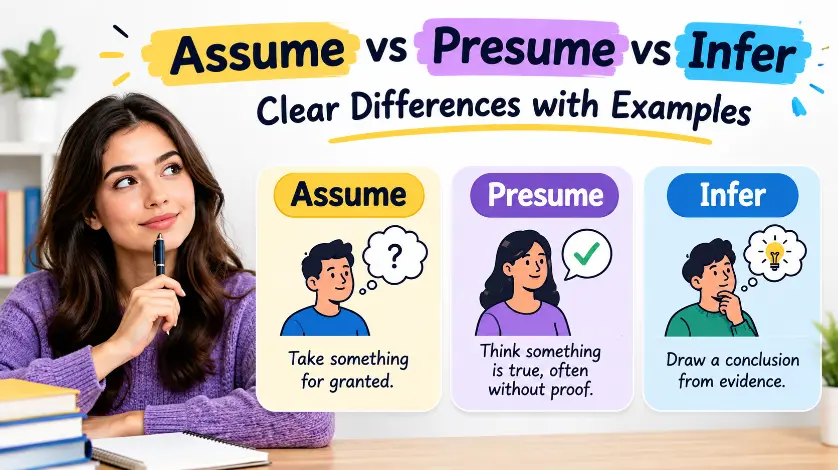
The difference between assume, presume, and infer is small on the surface, but it matters a lot in clear writing. These words all deal with reaching a conclusion, yet they do not do the same job. Assume is usually the broadest and most casual. Presume suggests a stronger basis, often a practical default or a legal-style expectation. Infer means you draw a conclusion from clues, evidence, or reasoning.
That is why people mix them up. In everyday speech, they overlap. In careful writing, they do not. Once you understand the logic behind assumption, presumption, and inference, the right choice becomes much easier, and your sentences sound sharper, more accurate, and more authoritative.
The Core Rule Explained Simply
Here is the simplest way to remember it, assume is what you believe without proof, presume is what you believe with some reason or as a default, and infer is what you conclude after examining evidence.
Assume means you take something for granted
When you assume something, you accept it as true before checking. It can be practical, careless, or neutral depending on the context. The key idea is that the conclusion arrives first, and verification may happen later, or not at all.
Example, “I assumed the meeting was canceled because no one showed up.”
Presume means you believe something is probably true
When you presume something, you are not always acting blindly. You may have a reason, a convention, or a logical default. In formal English, presume often sounds more careful than assume.
Example, “We presume the package was delivered, because the tracking record says so.”
Infer means you reach a conclusion from evidence
When you infer something, you are reading clues and drawing a reasoned conclusion. Someone else may state facts, and you connect the dots.
Example, “From the wet shoes and muddy floor, I inferred he had just come from outside.”
The shortcut
Assume = accept without checking.
Presume = accept as likely, or by default.
Infer = conclude from evidence.
Side-by-Side Comparison Table
| Situation | Example | Meaning | Correct Usage |
| You believe something before checking | “I assumed the store was open.” | A guess or taken-for-granted belief | Assume fits best |
| You accept something because it is the usual default | “We presume innocence until proven guilty.” | A formal or logical default | Presume fits best |
| You use clues to reach a conclusion | “She inferred the answer from the data.” | A conclusion drawn from evidence | Infer fits best |
| You make a polite, practical guess | “I presumed you were busy.” | A considerate or informed belief | Presume works well |
| You are stating what someone concluded | “He inferred the meaning correctly.” | Reasoning based on clues | Infer is the right verb |
Deep Dive into Category 1: Assume and Presume as Belief Before Proof
Let’s start with the family resemblance. Assume and presume both involve accepting something as true before full confirmation. That is why they are often confused. But they are not identical, and the difference is useful.
When to use assume
Use assume when there is little or no checking involved. It often suggests a jump to a conclusion. Sometimes that jump is harmless. Sometimes it is risky. The word feels broad, everyday, and flexible.
Examples:
- “I assumed you knew the instructions.”
- “Don’t assume the answer is obvious.”
- “She assumed the car would start, but the battery was dead.”
Assume is common in speech, writing, and teaching because it is simple. It works when you are talking about expectations, guesses, or beliefs that have not been tested.
When to use presume
Use presume when the belief is more justified, more formal, or based on a default expectation. It can sound more polished and deliberate. In many contexts, presume carries the feeling of “I have a reason to think this is true.”
Examples:
- “We presume the event is still on unless we hear otherwise.”
- “The law presumes innocence.”
- “I presume you have already read the report.”
Notice the tone. Presume often sounds more respectful than assume. If you say “I presume you are the manager,” you sound more careful than “I assume you are the manager.”
Quick Test for assume versus presume
Ask yourself:
- Is this a casual leap or unchecked belief, then assume.
- Is this a reasonable default or formal expectation, then presume.
- Am I talking about evidence and reasoning, then neither, use infer.
Pattern guide
Think of assume as the broader word.
Think of presume as the more cautious or formal word.
Think of infer as the evidence-based word.
That pattern alone fixes a lot of confusion.
Deep Dive into Category 2: Infer as the Reasoning Word
Now let’s focus on infer, because this is where many writers make mistakes.
When to use infer
Use infer when someone looks at evidence, clues, or data and reaches a conclusion. The conclusion does not appear from nowhere. It is built from observation.
Examples:
- “From her tone, I inferred she was annoyed.”
- “The detective inferred the suspect’s route from the footprints.”
- “Students can infer the theme from repeated symbols.”
The central idea is reasoning from evidence. That is what separates infer from the other two words.
What infer is not
Infer is not a random guess. It is not a hunch made in the dark. It is not simply believing something because it feels right. It is a conclusion supported by clues.
That means this is correct:
- “I inferred that the shop was closed from the dark windows.”
This is not as precise:
- “I inferred the shop was closed because I felt like it.”
Common mistake, confuse infer and imply
Many people also mix up infer and imply. They are related, but they move in opposite directions.
- Imply means the speaker or writer suggests something.
- Infer means the listener or reader deduces something.
Example:
- “Her comment implied that the project was behind schedule.”
- “I inferred from her comment that the project was behind schedule.”
That pair is worth remembering because it shows the direction of meaning.
Quick checklist for infer
Use infer when:
- You have evidence, clues, or signals.
- You are connecting dots.
- The conclusion is reasoned, not guessed.
- The sentence focuses on what someone concluded from information.
The Meaning Shift, or Nuance
The subtle difference among these words is mostly about certainty, method, and tone.
Assume is the least demanding. It often means you act as if something is true without checking.
Presume adds a stronger sense of probability, custom, or formality.
Infer is about thought process, not default belief, because it depends on evidence.
Here is the nuance in one line, assume and presume are about what you accept, infer is about how you conclude.
That is the heart of the distinction.
Another useful way to see it is this:
- Assume can be wrong for no good reason.
- Presume is wrong less casually, because it usually rests on a rationale.
- Infer may still be wrong, but it is wrong because the evidence was incomplete, not because the reasoning step was careless.
That is why formal writing often prefers presume over assume in legal, academic, or procedural contexts. It sounds more measured.
Why the Confusion Persists
This confusion sticks around for several reasons.
First, all three words deal with thinking before certainty. In real life, people do not always separate the steps neatly. They see something, guess something, and conclude something all at once. Language gets messy because thinking gets messy.
Second, everyday speakers often use assume for almost everything. It is a convenient default. Because it is so common, people start using it where presume or infer would be more accurate.
Third, education sometimes teaches these words through isolated definitions instead of real examples. Students memorize lists but do not practice the logic of the sentence. That creates surface familiarity, not real control.
Fourth, infer is often taught together with imply, and that doubles the confusion. People are trying to remember two pairs at once, and the distinctions blur.
Finally, modern communication rewards speed. Text messages, social media posts, and quick emails encourage shortcuts. In that environment, many people stop noticing the fine difference between a casual assumption and a careful inference.
Formal vs Casual Contexts
Context changes everything.
In casual speech
People often use assume when they really mean presume. That is normal in conversation.
Example:
- “I assumed you were coming.”
That sentence is natural, even if the speaker had some reason to think so.
In casual talk, nobody usually pauses to distinguish every nuance. The goal is fast communication, not precision.
In formal writing
Precision matters more. Legal, academic, journalistic, and professional writing benefits from choosing the exact word.
Examples:
- “The court presumes innocence.”
- “The researcher inferred a pattern from the data.”
- “The editor assumed the draft would arrive on time.”
Each word carries different weight. Using the wrong one can make your writing sound vague or careless.
In academic writing
Infer is especially important in analysis, interpretation, and research. It often appears when authors discuss conclusions drawn from data, texts, or observations.
Example:
- “From the survey results, we infer that user satisfaction has increased.”
Presume can appear in formal logic, law, or rule-based writing.
Assume appears when setting conditions, hypotheses, or background beliefs.
In business writing
Business writing tends to favor clarity and neutrality. That means assume is fine when you are describing an unchecked expectation, while presume works when the expectation is based on policy or convention.
Example:
- “We presume all invoices are accurate unless flagged.”
- “I assume the team already has access.”
- “We infer that the delay came from the vendor’s system outage.”
Case Studies and Pop Culture Examples
Real-world examples make the difference easier to feel.
Legal language
One of the most famous uses of presume is in the phrase presumed innocent. This is not a casual guess. It is a legal default. The system begins with a presumption, and proof is required to change it.
That is exactly why presume sounds stronger and more formal than assume.
Detective stories
Mystery fiction is full of inferences. A detective sees a broken window, muddy footprints, and a missing key, then infers what happened. The reader does the same thing.
This is the natural home of infer. It is the word of pattern recognition and deduction.
Classroom examples
Teachers often ask students to infer a character’s motivation from a story. The student is not told the answer directly. The student reads clues and makes a conclusion.
That is why infer belongs to reading comprehension, analysis, and interpretation.
Everyday life
Suppose a friend arrives late, with wet hair and a dripping umbrella. You might infer it rained. You might assume they were delayed by traffic. You might presume they forgot to text you. Those are not identical moves.
The best word depends on the evidence and the tone.
Pop culture dialogue
In movies and TV shows, characters often say things like, “I presume you have a plan.” That sounds polished, dry, or even slightly dramatic.
A line like, “I assume you know what you are doing,” sounds more direct and less formal.
A line like, “I infer from your silence that you disagree,” sounds analytical, maybe even tense.
That tonal difference matters a lot in dialogue writing.
Advanced Scenarios and Flowchart
Here is a practical decision path you can use when choosing among the three.
Start here:
Do you mean someone is drawing a conclusion from clues?
- Yes, use infer.
- No, go to the next step.
Are you talking about a belief taken for granted, without proof?
- Yes, use assume.
- No, go to the next step.
Are you talking about a formal, justified, or default expectation?
- Yes, use presume.
- No, revisit the sentence, because the word may not fit.
Now test it again with a full sentence.
If the sentence sounds like a guess, assume probably fits.
If it sounds like an established default or polite expectation, presume probably fits.
If it sounds like a conclusion from clues, infer is the right verb.
Edge cases to watch
Sometimes assume and presume can both work, but the tone changes.
Example:
- “I assume you will attend.”
- “I presume you will attend.”
The first sounds more casual.
The second sounds more formal or slightly more courteous.
Another edge case:
- “We infer that sales are rising.”
This works only if there is visible evidence, such as numbers, trends, or records. Without evidence, the sentence weakens fast.
Quick Reference Table
| Word | Fast Meaning |
| Assume | Believe without checking |
| Presume | Believe as a likely or default truth |
| Infer | Conclude from evidence |
Common Mistakes That Lower Quality
Even experienced writers get these wrong.
Using infer when they mean assume
This is one of the most common mistakes. If there is no evidence in the sentence, infer is probably wrong.
Wrong: “I inferred he was home, so I called.”
Better: “I assumed he was home, so I called.”
Using assume in formal defaults
Sometimes presume is the better choice because it sounds more precise.
Less strong: “We assume innocence until proven guilty.”
Better: “We presume innocence until proven guilty.”
Forgetting the evidence requirement for infer
If the sentence does not mention clues, data, observation, or reasoning, the verb may be off.
Wrong: “I inferred that you are busy because I wanted to.”
Better: “I presumed you were busy.” Or, if you truly had evidence, “I inferred you were busy from your delayed replies.”
Mixing up tone with meaning
Sometimes writers choose a word only because it sounds fancy. That can backfire. Clarity should win over style.
Using the same verb for all three ideas
A paragraph that keeps repeating one word creates dull, imprecise writing. A sharper paragraph uses each verb only where it belongs.
Memory Hacks That Actually Work
Here are practical tricks that hold up.
1. The evidence trick
Infer = evidence first, conclusion second.
If you can point to clues, use infer.
2. The default trick
Presume = the rule, custom, or likely default.
If it feels like a formal assumption built into the situation, use presume.
3. The blind-guess trick
Assume = taking it as true before checking.
If nobody verified it, assume is usually your word.
4. The direction trick
- Speaker or writer suggests, imply.
- Reader or listener concludes, infer.
This is not the same as assume versus presume, but it helps keep the whole family straight.
5. The courtroom trick
Think of presume in legal and formal settings.
Think of infer in detective and research settings.
Think of assume in everyday guesswork and defaults.
That image alone helps many people remember the difference.
Why Precision Matters, SEO and Authority
Precise word choice builds trust. That matters in essays, blog posts, reports, landing pages, and brand communication. Readers may not consciously notice every distinction, but they absolutely feel the difference between careful language and sloppy language.
Using assume, presume, and infer correctly signals that you understand both meaning and nuance. That improves credibility, authority, and reader confidence. It also reduces ambiguity, which is critical when you are explaining complex ideas, making an argument, or teaching language rules.
From an SEO perspective, precision also helps because clear writing is easier to scan, easier to understand, and more likely to satisfy search intent. When a page fully answers the difference between similar words, it gives readers the clarity they came for. That keeps them engaged longer, and it makes the content feel more useful.
In other words, accurate language is not just a grammar win, it is a content-quality win.
A Quick Quiz
Fill in the blanks with assume, presume, or infer.
- I did not hear from her, so I __________ she was still traveling.
- The detective __________ the suspect’s route from the footprints.
- The law __________ innocence until proven guilty.
- From the broken vase and the loud crash, we __________ what happened.
- Please do not __________ the answer before checking the data.
- I __________ you have already seen the latest version of the report.
- The teacher asked students to __________ the theme from the poem.
- We __________ the meeting will start on time unless notified otherwise.
Answer key:
- assumed
- inferred
- presumes
- inferred
- assume
- presume
- infer
- presume
The best way to master these words is to slow down for one second and ask a simple question, am I guessing, defaulting, or reasoning from evidence? That one question usually points you to the right verb.
Conclusion
Choosing between assume, presume, and infer becomes much easier once you understand the thinking process behind each word. Assume is the broad, everyday choice for accepting something without checking. Presume suggests a stronger foundation, whether that comes from logic, convention, or a formal rule. Infer, on the other hand, requires evidence. It is the act of connecting clues and drawing a reasoned conclusion rather than making a simple guess. While these words occasionally overlap in casual conversation, they serve distinct purposes in precise writing. Using the correct one improves clarity, prevents misunderstandings, and helps readers follow your intended meaning without confusion. Whether you are writing emails, essays, reports, or website content, selecting the right term demonstrates stronger communication skills and greater attention to detail.
The key to mastering these words is to focus less on memorizing dictionary definitions and more on recognizing the context in which each verb belongs. Before choosing one, ask yourself whether you are making an unchecked belief, relying on a reasonable default, or reaching a conclusion from evidence. That quick mental check will usually lead you to the correct choice. Over time, this distinction becomes second nature and significantly improves the quality of both your writing and speaking. Accurate word selection also builds credibility, especially in academic, legal, and professional settings where precision matters. By consistently applying these simple rules, you will avoid one of the most common vocabulary mistakes in English and communicate your ideas with greater confidence and authority.
Frequently Asked Questions
Can assume and presume ever mean the same thing?
Yes, in many everyday conversations, assume and presume can express a similar idea because both involve accepting something as true before complete proof exists. However, presume usually implies that there is at least some logical reason, accepted convention, or default expectation behind the belief. Assume is broader and often suggests a simple guess or an unverified belief. In formal writing, choosing the more precise word helps improve clarity.
Is infer the opposite of imply?
Not exactly, but they work together. Imply is what a speaker or writer does when suggesting something indirectly. Infer is what the listener or reader does when drawing a conclusion from those suggestions. If someone implies a message, another person may infer its meaning. Remembering this relationship helps prevent one of the most common English vocabulary mistakes.
Why is presume common in legal English?
Legal language often relies on established principles rather than guesses. For example, courts presume innocence until proven guilty, meaning innocence is treated as the default legal position until sufficient evidence proves otherwise. This is different from an assumption because it is based on a formal rule rather than personal belief. That is why presume is preferred in legal and procedural contexts.
Can I use assume in academic writing?
Yes, but it should be used carefully. In academic writing, assume often introduces hypotheses, conditions, or accepted starting points for analysis. However, if you are discussing conclusions drawn from research or evidence, infer is usually the better choice. Selecting the correct verb makes your arguments more precise and strengthens the overall quality of your academic work.
How do I know when to use infer?
Use infer whenever your conclusion comes from evidence, observations, or logical reasoning. If you are examining facts, identifying patterns, or connecting clues before reaching an idea, infer is the correct choice. If there are no supporting clues and you are simply believing something to be true, you should probably use assume or presume instead.
Which word sounds more formal, assume or presume?
Presume generally sounds more formal and polished than assume. It frequently appears in legal documents, official policies, academic writing, and professional communication. Assume is more common in everyday conversation and informal writing because it feels more direct and conversational. The difference is often one of tone rather than basic meaning.
Why do English learners confuse these three words?
These words are confusing because they all involve reaching or accepting a conclusion before absolute certainty exists. Many dictionaries define them using similar language, and casual conversation often ignores the subtle differences. Without enough real-life examples, learners struggle to recognize when a conclusion comes from evidence, when it is a default expectation, or when it is simply an unchecked belief.
Can an inference be wrong?
Yes. An inference is based on available evidence, but evidence can be incomplete or misleading. Even when someone reasons logically, new information may later prove the conclusion incorrect. The important distinction is that an inference is supported by observable facts or clues, unlike a random assumption that may have little or no evidence behind it.
What is the easiest way to remember assume, presume, and infer?
A simple memory trick is to think of three levels. Assume means you accept something without checking. Presume means you accept something because it is probably true or is the expected default. Infer means you study clues and reach a logical conclusion. Asking yourself whether you are guessing, defaulting, or reasoning from evidence usually leads to the correct choice.
Are these words important for SEO and professional writing?
Absolutely. Precise vocabulary improves readability, reduces ambiguity, and increases reader trust. Search engines reward content that clearly satisfies user intent, and readers are more likely to stay engaged when explanations are accurate and easy to understand. Using assume, presume, and infer correctly also strengthens your credibility in blogs, business documents, educational content, and professional communication.

Amelia Brooks is a dedicated writer and English enthusiast who believes great writing starts with clear, simple language. At GrammarFixery, Amelia creates helpful content that makes grammar, vocabulary, sentence structure, and everyday English easier to understand. Her goal is to turn confusing language rules into practical guidance readers can use with confidence. From students and professionals to English learners and content creators, Amelia helps readers strengthen their writing, communicate their ideas clearly, and feel more confident with every word they write.