
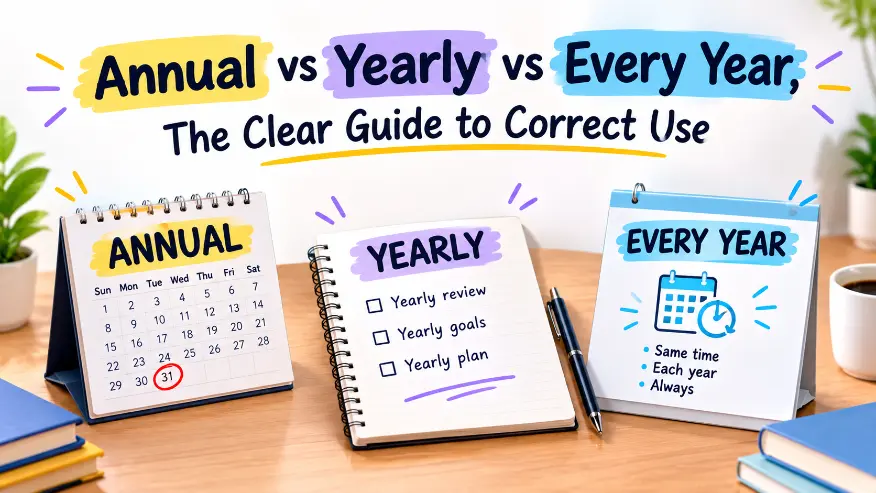
Annual, yearly, and every year all point to a 12 month cycle, but they do not always behave the same way. That is where the confusion starts. One word sounds more formal, one feels more conversational, and one is a phrase that often works in simple everyday speech. If you are writing professionally, editing content, or just trying to sound precise, this distinction matters more than most people think.
Here is the simple truth, annual and yearly are often close in meaning, but they are not always interchangeable in every sentence. Every year is the most direct phrase, and it usually works when you want clarity fast. The problem is not the calendar. The problem is usage, tone, and context.
Let’s make this concrete. A company can hold an annual meeting, publish an annual report, or review its budget every year. A person can take a trip yearly, though many writers would still choose every year for a cleaner, more natural sentence. Once you see how the words behave, the whole topic gets much easier.
The Core Rule Explained Simply: Strip the Concept Down to Its Absolute Basics
The core rule is simple, annual usually acts like a formal adjective, yearly often acts like a regular adjective or adverb, and every year is a plain phrase that states the timing directly.
That means all three can point to repetition once per year, but they do not do it with the same style.
Annual is the most formal and institutional option. You see it in business, education, government, and event planning.
Yearly is easier, softer, and more conversational. It feels less technical.
Every year is the most literal. It is often the easiest to understand at a glance.
Here’s the key idea, the meaning overlaps, but the function changes.
Annual, the formal choice
Annual usually describes something tied to a single year cycle. It often appears before a noun, like annual report, annual leave, or annual subscription. In many cases, it sounds polished and professional.
Yearly, the flexible everyday choice
Yearly usually means once per year, but it feels more natural in casual explanation. It can work as an adjective or adverb, depending on the sentence. Writers often use it when they want plain English instead of corporate language.
Every year, the clearest phrase
Every year is not a single word. It is a phrase that says the same timing in direct language. When clarity matters most, this is the easiest option for readers of all levels.
Side-by-Side Comparison Table
| Situation | Best Choice | Example | What It Suggests |
| Formal document | Annual | annual review | Professional, established, official |
| Casual explanation | Yearly | yearly checkup | Simple, conversational, everyday |
| Maximum clarity | Every year | We renew every year | Direct, explicit, easy to follow |
| Before a noun | Annual | annual meeting | Standard and polished |
| After a verb | Yearly or every year | We meet yearly | Natural repetition wording |
This table shows the real pattern. The meaning is close, but the shape of the sentence changes the best choice.
Deep Dive into Category 1: Annual
Annual is the word people reach for when they want a formal, compact, and professional tone. It is especially common in business, finance, education, medicine, and event language. It often appears right before a noun, and that makes it feel structured.
Look at this:
Annual report
Annual salary
Annual conference
Annual maintenance
Annual subscription
Those are all normal, standard phrases. In these examples, annual does more than say “once a year.” It gives the phrase a formal identity.
When to use annual
Use annual when the phrase sounds like a fixed institution, calendar event, or official cycle. It works well when the word is modifying a noun directly.
For example:
The company released its annual report in March.
We have an annual inspection every spring.
The school hosts an annual festival for students and families.
In each case, annual feels natural because it belongs in a formal noun phrase.
What annual does best
Annual is great for branding, documentation, and official communication. It can make a topic sound stable, recognized, and important. That is one reason businesses love it. It creates a sense of routine without sounding casual.
Quick test for annual
Use this checklist:
Is the word before a noun?
Does the phrase sound official or institutional?
Would the sentence fit in a report, policy, or announcement?
Does the phrase already feel like a standard label?
If the answer is yes to most of those, annual is probably the strongest choice.
Examples that feel right
The museum publishes an annual guide.
She received an annual bonus.
The charity holds an annual fundraiser.
The team completed its annual audit.
These examples sound crisp because annual gives them a formal frame.
Deep Dive into Category 2: Yearly and Every Year
Yearly and every year are often the practical alternatives. They are easier to say, easier to understand, and less formal than annual. They work especially well in ordinary writing, conversation, and explanations meant for general readers.
Yearly, the smoother conversational form
Yearly often feels like a natural middle ground. It is still concise, but it is not as institutional as annual. You can use it in many of the same contexts, especially when the sentence is more descriptive than official.
Examples:
We meet yearly to review progress.
The doctor recommends a yearly exam.
The fee is charged yearly.
In the last example, yearly works as an adverb. That flexibility is one reason writers like it.
Every year, the clearest phrase
Every year is the best choice when you want zero ambiguity. It is especially useful in teaching, editing, and plain-language writing. It tells the reader exactly what you mean without relying on a formal label.
Examples:
We visit my grandparents every year.
The festival happens every year in July.
The company updates the software every year.
This phrase is often the safest option when you are unsure whether a reader will understand a more formal word.
Pattern to notice
Here is a useful pattern:
Use annual when you want a fixed label.
Use yearly when you want a light, flexible word.
Use every year when you want the clearest possible timing.
That pattern solves most sentence choices instantly.
The Meaning Shift, or Nuance
The subtle difference is not about the calendar, it is about tone, structure, and precision.
Annual tends to sound official and sometimes more permanent. It often suggests an established event, report, fee, or process.
Yearly feels less formal and sometimes more human. It can describe repeated habits, checks, visits, or payments.
Every year strips away style and goes straight to meaning. It is the most transparent option.
So while all three point to repetition across a year, the reader receives a different signal from each one. That signal matters in business writing, SEO content, educational material, and polished communication.
Here is a simple way to think about it.
Annual says, this belongs to the official yearly cycle.
Yearly says, this happens once each year.
Every year says, this happens each time a year passes.
That nuance is small, but in good writing, small differences create big quality gains.
Why the Confusion Persists
The confusion persists because English often gives us multiple ways to say nearly the same thing. That is useful, but it also creates hesitation.
One reason is that annual appears in set phrases far more often than yearly. People learn annual report, annual meeting, and annual income as fixed expressions, then assume they can swap it freely everywhere. Sometimes they can. Sometimes the sentence sounds awkward.
Another reason is education. Many learners are told the words are synonyms, which is partly true, but not the full story. Synonyms can still differ in tone, placement, and common usage. That detail gets lost in basic instruction.
There is also the influence of professional writing. Business language often favors annual because it sounds precise and established. Everyday language often favors every year because it is easier to process. Yearly sits in the middle, which makes it feel less decisive to writers who want one perfect rule.
Look at this:
The policy is reviewed annual? No, that sounds wrong.
The policy is reviewed yearly.
The policy is reviewed every year.
The confusion persists because not every word works in every position. A phrase can be correct in meaning but awkward in structure.
Formal vs Casual Contexts
Context changes everything.
In formal writing, annual usually wins. It fits reports, contracts, business pages, academic writing, and official notices. It sounds tight and professional.
Examples:
annual revenue
annual maintenance plan
annual evaluation
annual enrollment period
Those phrases feel normal because the formality matches the setting.
In casual writing, yearly or every year often feels better. They sound more conversational and easier to read.
Examples:
We go there every year.
I get a yearly checkup.
We buy a new calendar every year.
In spoken English, people often choose whatever is shortest and most natural in the moment. That usually means every year in plain conversation. In polished writing, style matters more, so the choice becomes more deliberate.
Here is the rule of thumb:
Formal environment, lean toward annual.
Casual environment, lean toward yearly or every year.
Need maximum clarity, choose every year.
Case Studies / Pop Culture Examples
Real-world language shows these differences clearly.
Business and finance
A company issues an annual report, not a yearly report, because the phrase is an established formal label. The word annual carries authority and tradition. It sounds like something audited, filed, and reviewed.
Education
Schools often use annual exams, annual ceremonies, and annual calendars. These are fixed institutional phrases. The word helps the schedule feel official.
Health and personal care
People more often say yearly checkup or every year for routine health visits. Both work, but yearly feels friendlier and less stiff.
Pop culture and events
Award shows, festivals, and conventions often use annual in promotional language. Think of phrases like annual music festival or annual fan convention. The word signals tradition and repetition.
Everyday speech
In conversation, a person is more likely to say, “We go camping every year,” than “We go camping annually,” unless they want to sound formal or precise.
That is the hidden truth. Different settings reward different forms.
Advanced Scenarios & Flowchart
Sometimes the choice is not obvious. That happens when the sentence mixes tone, grammar, and audience expectations.
Use this text-based decision flowchart.
Need to describe something happening once per year?
Yes
Is it part of an official label or title?
Yes
Use annual
No
Is the tone formal or professional?
Yes
Use annual
No
Do you want plain, direct language?
Yes
Use every year
No
Use yearly
No
Do not use these words for the timing.
Let’s make that even simpler.
If the word sits before a noun and the context is formal, choose annual.
If the sentence is a normal statement and you want to sound natural, choose yearly.
If you want the most reader-friendly version, choose every year.
Advanced example 1
The committee conducts an annual review of the policy.
Why this works, annual is part of a formal noun phrase.
Advanced example 2
The committee reviews the policy every year.
Why this works, it is direct and easy to understand.
Advanced example 3
The committee conducts a yearly review of the policy.
Why this works, it is acceptable, but it feels less institutional than annual review.
Quick Reference Table
| Term | Best Use |
| Annual | Formal noun phrases, official documents, fixed institutional language |
| Yearly | Casual or semi-formal repetition, flexible everyday usage |
| Every year | Plain-English clarity, direct explanation, easy reading |
Use this table when you need a fast decision.
Common Mistakes That Lower Quality
Even experienced writers make these errors.
Mistake 1, using annual everywhere
Not every yearly idea sounds best with annual. Some phrases feel too stiff or unnatural. A sentence can be correct in meaning and still sound clunky.
Mistake 2, forcing yearly into formal labels
Some official phrases simply prefer annual. Yearly report may sound understandable, but annual report is the more standard form.
Mistake 3, mixing tone without noticing it
A paragraph that starts formally and then turns casual can feel uneven. If you are writing a report, do not suddenly switch to conversational wording without a reason.
Mistake 4, confusing adjective and adverb roles
Annual usually modifies a noun.
Yearly can modify a noun or a verb.
Every year is a phrase, not a single-word modifier.
That difference matters.
Mistake 5, choosing the word that sounds smartest instead of the one that reads best
The clearest word is usually the strongest word. Good writing is not about sounding impressive. It is about being accurate and easy to follow.
Memory Hacks That Actually Work
Here are practical ways to remember the difference.
Hack 1, think annual = official
If it sounds like a report, meeting, fee, or policy, annual is probably the right word.
Hack 2, think yearly = everyday
If you would say it in conversation, yearly may fit naturally.
Hack 3, think every year = zero confusion
If you want the clearest possible message, say every year.
Hack 4, use the noun test
If the word is right before a noun, check whether the phrase sounds like a standard formal label. If yes, try annual.
Hack 5, read it out loud
Does it sound stiff, overly casual, or awkwardly technical? Hearing the sentence often makes the best choice obvious.
Hack 6, remember the trio as a ladder
Annual, most formal.
Yearly, middle ground.
Every year, most direct.
That ladder is easy to recall under pressure.
Why Precision Matters, SEO and Authority
Precision matters because readers trust writing that sounds intentional. When you choose the right word, the content feels more credible. That credibility helps in professional communication, educational material, and SEO content.
Search engines also reward clarity. When an article uses terms naturally and consistently, it is easier for users to scan, understand, and stay engaged with it. That matters for ranking and for retention.
In SEO, annual, yearly, and every year may all attract similar intent, but the best pages explain the difference clearly. That is because readers are not only searching for definitions. They are searching for confidence.
Precise usage also builds authority. A writer who understands nuance sounds more reliable than a writer who repeats synonyms without explanation.
Look at it this way, language is part meaning and part signal. The word you choose tells the reader whether the topic is formal, casual, institutional, or plainspoken. That signal shapes the whole piece.
So getting this right is not a tiny detail. It is part of strong, trustworthy writing.
A Quick Quiz, Fill in the Blanks
- The company released its ______ report last Friday.
- We visit our cousins ______.
- The school holds an ______ ceremony in spring.
- The doctor recommends a ______ checkup.
- The membership fee is charged ______.
- The policy is reviewed ______ by the board.
- For maximum clarity, say ______ when you want to avoid confusion.
- In a formal document, ______ is usually the strongest choice before a noun.
Answer Key
- annual
- every year
- annual
- yearly
- yearly or annually
- yearly or every year
- every year
- annual
By now, the pattern should feel simple. Annual is formal and structured, yearly is flexible and conversational, and every year is the clearest plain-English option. Use the one that matches the sentence, the audience, and the tone. That is the whole rule, and once you apply it, your writing instantly sounds sharper, cleaner, and more confident.
Conclusion
Choosing between annual, yearly, and every year is less about meaning and more about context, tone, and sentence structure. While all three refer to something that happens once every twelve months, they are not always the best fit in the same situations. Annual is the preferred choice for formal writing, business documents, official events, and established expressions like annual report or annual meeting. Yearly offers a more conversational feel and works naturally in everyday communication, while every year provides the clearest and most direct wording when simplicity is the goal. Understanding these subtle distinctions helps you write with greater confidence and prevents awkward or unnatural phrasing that can distract readers.
Mastering this small grammar distinction can make a noticeable difference in the quality of your writing. Whether you are creating website content, preparing academic work, writing professional emails, or publishing SEO articles, selecting the right expression improves both readability and credibility. Instead of memorizing complicated grammar rules, focus on the purpose of the sentence and the audience you are writing for. If the context is formal, choose annual. If you want a relaxed tone, use yearly. If your priority is absolute clarity, every year is usually the safest option. Consistently making the right choice will strengthen your communication skills and help your writing appear more polished, natural, and authoritative.
Frequently Asked Questions
Is annual more formal than yearly?
Yes. Annual generally carries a more formal and professional tone than yearly. It is commonly used in business, legal, financial, educational, and governmental contexts. Phrases like annual report, annual conference, and annual budget have become standard expressions. Although yearly has a similar meaning, it often sounds more conversational and is better suited to everyday writing.
Can I replace annual with every year?
In many sentences, you can replace annual with every year, but the tone will change. Every year is more direct and conversational, while annual sounds more official. For example, “The company holds an annual meeting” can become “The company holds a meeting every year,” but the second version feels less formal and slightly less polished.
Which is better for SEO, annual, yearly, or every year?
There is no universally better keyword because the best choice depends on search intent. Many SEO writers naturally include all three expressions where appropriate to match how users search online. Using each term correctly, rather than forcing repetition, creates content that is easier to read and more relevant to both readers and search engines.
Is yearly considered incorrect in formal writing?
No. Yearly is grammatically correct and acceptable in formal writing. However, many professional style guides and organizations prefer annual for official documents and recurring institutional events because it has become the conventional choice. Yearly remains perfectly acceptable when it fits the tone and sentence structure.
Why do companies usually say annual report instead of yearly report?
The phrase annual report has become a recognized business and legal term over many decades. Readers immediately associate it with official financial reporting and corporate communication. Although yearly report is understandable, it lacks the same level of convention and professionalism, making annual report the preferred expression.
Is every year easier for English learners?
Yes. Every year is often the easiest option because it expresses the idea directly without requiring learners to understand differences in style or grammatical function. It is widely used in spoken English and simple writing, making it an excellent choice when clarity is more important than formality.
Can annual and yearly both describe subscriptions or payments?
Yes. Both words can describe recurring payments, subscriptions, or memberships. For example, you might see annual subscription, annual fee, yearly membership, or yearly payment. In commercial and professional settings, annual is generally more common, while yearly appears more frequently in everyday communication.
Which expression sounds most natural in conversation?
In casual conversation, every year is usually the most natural choice because it is simple, familiar, and easy to understand. Yearly also sounds natural in many situations, but annual is less common in everyday speech unless discussing official events, business matters, or established terms.
How can I quickly decide which one to use?
A simple rule works well in most situations. Choose annual when writing formally or naming an official event, report, or policy. Choose yearly for a friendly, conversational style. Choose every year whenever you want the clearest and most straightforward wording. Thinking about your audience and the purpose of the sentence will usually lead you to the best choice.

Noor Sullivan is a passionate writer and English enthusiast dedicated to making language easier to understand and use. At GrammarFixery, Noor creates clear, practical content covering grammar, vocabulary, word meanings, sentence structure, and everyday English. With a friendly and straightforward approach, Noor helps readers turn confusing language questions into useful answers. Whether you are a student, professional, writer, or English learner, Noor’s guides are designed to build confidence, improve writing, and make communicating ideas feel natural and effortless.