
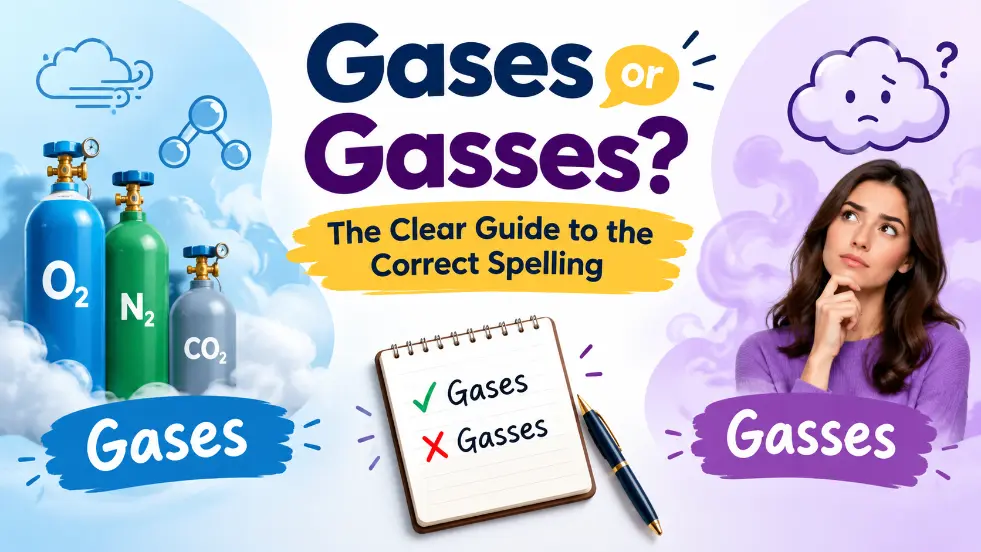
The phrase gases or gasses looks simple at first, but it causes real confusion in writing, editing, and search. One form is the standard plural of gas, and the other is a much less common variant that appears in specific contexts. That tiny spelling difference can change how polished, credible, and precise your writing feels.
Here’s the good news, the rule is easy once you strip away the noise. In most cases, gases is the correct plural, and gasses is either a verb form or a rare spelling variant. Let’s make that distinction clear, fast, and unforgettable.
The Core Rule Explained Simply
At the most basic level, gases is the normal plural noun for more than one gas. You use it when talking about air pollution, fuel, chemistry, weather, medicine, or any other situation where the noun gas becomes plural. That is the default choice in modern English.
Gasses, on the other hand, is usually not the plural noun you want. Most of the time, it shows up as the third-person singular verb form of to gas, as in “he gasses up the car,” or in a few specialized or older uses. In standard everyday writing, the plural noun is gases, not gasses.
The noun side, use gases
When you are naming more than one substance in a gaseous state, gases is the correct plural. Think of greenhouse gases, noble gases, toxic gases, and industrial gases. The noun stays clean, predictable, and widely accepted.
The verb side, use gasses
When the word is a verb, gasses can be correct. For example, “the engine gasses the cabin with fumes” or “she gasses up the truck.” In those cases, the word is not plural at all, it is an action word. That is the key difference.
Side-by-Side Comparison Table
| Situation | Example | Meaning | Correct Usage |
| More than one gas | greenhouse gases | plural noun | gases |
| Scientific writing | noble gases | plural noun | gases |
| Fueling a vehicle | he gasses up the car | verb | gasses |
| Older or less common style | gasses as a noun variant | rare usage | usually avoid it |
This table solves most confusion right away. If you are naming substances, go with gases. If you are describing an action, gasses may be the right verb form.
Deep Dive into Category 1, the Noun Gases
When to use it
Use gases whenever you mean the plural of gas. This includes scientific, technical, and everyday contexts. The word appears in textbooks, reports, news stories, health articles, and environmental discussions. It is the standard form in modern English.
Examples make this easier. You would say “The factory released several harmful gases.” You would also say “Scientists study the behavior of noble gases.” In both cases, the word refers to more than one gas, so gases is the correct spelling.
What it sounds like in real writing
Gases sounds normal because it follows the familiar English pattern for plural nouns ending in s-like sounds. Readers expect it. Editors expect it. Search engines expect it too, which is why it matters in SEO content and reference writing.
Look at this:
The air contained different gases after the fire.
That sentence feels natural. It is clean, readable, and standard. Swap in gasses, and many readers will pause, because the spelling looks off in plural-noun form.
Quick Test for gases
Use this fast checklist.
If you can answer “yes” to any of these, gases is probably right:
- Are you talking about more than one substance?
- Is gas being used as a noun?
- Would you replace it with substances or elements and still keep the sentence meaning?
- Does the sentence describe chemistry, pollution, or physical state?
- Are you writing for a general audience, school, business, or publication?
If the answer is yes, choose gases.
Common examples of gases
Here are the kinds of phrases where gases belongs:
- Greenhouse gases
- Noble gases
- Toxic gases
- Industrial gases
- Exhaust gases
- Combustion gases
Each one uses the plural noun. None of these needs gasses. That is why gases is the safer, stronger, more authoritative choice in most writing.
Deep Dive into Category 2, the Verb or Rare Form Gasses
When to use it
Gasses can be correct when it is part of the verb to gas. In that role, it usually means to fill with gas, supply with gas, or affect with gas. You will see it in sentences like “He gasses the machine” or “She gasses up the lawn equipment.”
This use is much narrower than the noun. That is why many writers never need it at all. If you are simply talking about more than one gas, the verb form is irrelevant. But if the sentence is about an action, then gasses may belong.
Patterns that show the verb form
The easiest way to spot the verb is to look at the subject. If the subject is a person, machine, or process doing something, the word may be a verb. For example:
- The mechanic gasses up the truck.
- The system gasses the chamber.
- The worker gasses the tank carefully.
In these sentences, the word is not plural. It is an action. That is why the spelling ends with -es, the same way many third-person singular verbs do.
Why this form causes trouble
Most confusion happens because gasses looks almost identical to a plural noun. Readers see the double s and assume it must mean “more than one gas.” But English does not always cooperate with instinct. Here, spelling follows grammar, not appearance.
So the simple rule is this. If the word names things, use gases. If the word shows action, gasses may be right. That one distinction handles most cases without extra stress.
The Meaning Shift, or Nuance
The meaning shift between gases and gasses is subtle, but important. One form is a noun, the other is usually a verb. That means the difference is not just about spelling, it is about sentence function.
That matters because writing quality depends on function. A good writer does not just recognize letters, they recognize grammar roles. The wrong choice can make a sentence look careless, even when the idea behind it is strong.
Here is the nuance in plain language. Gases describes what something is. Gasses describes what something does. Once you see that contrast, the spelling issue becomes much easier to manage.
Why the Confusion Persists
There are a few reasons people mix up gases or gasses. First, English plural forms are inconsistent, so learners often expect one pattern and get another. Second, many people rarely write about chemistry or fuel systems, so they do not see the correct form often enough to internalize it.
There is also a visual problem. Gasses looks more “balanced” to some readers because it seems to echo the singular gas with an extra ending. That makes it feel plausible, even when it is not the standard plural noun. The eye can be persuasive, but grammar still wins.
Education gaps also matter. People may hear the word spoken clearly, but never see it written in a trustworthy source. When that happens, spelling gets guessed instead of learned. And guessing is exactly how this confusion survives.
Formal vs Casual Contexts
In formal writing, gases is the safest and most professional choice for the plural noun. That includes academic papers, business reports, journalism, SEO articles, and educational content. Readers expect correctness, and standard spelling builds trust quickly.
In casual writing, people are sometimes looser with spelling, but the rule still holds. A text message or informal note might not be judged as harshly, yet gases remains the cleaner option for the plural noun. Even in relaxed settings, the standard form looks more polished.
The verb gasses is more likely to appear in technical or practical contexts, like automotive writing or mechanical instructions. Outside those contexts, many readers may never need to use it. So if you are unsure, default to gases for the noun and avoid unnecessary risk.
Case Studies and Pop Culture Examples
Science writing gives us some of the clearest examples. In environmental articles, you will often see greenhouse gases because the phrase describes a category of emissions. In chemistry, noble gases appears constantly because it refers to a group of elements. In both cases, the plural noun is obvious and standard.
Look at everyday language too. News reports about climate, air quality, and industrial safety often use gases when discussing leaks, fumes, or atmospheric composition. The spelling is not decorative, it signals accuracy. When the subject is serious, precision matters more.
Pop culture examples can help too. In food and beverage branding, carbonation is often discussed in terms of gases trapped in drinks. In automotive culture, the phrase gasses up is common when talking about refueling. One is a noun, the other is a verb. That split is exactly what makes this pair memorable.
A few realistic examples
- The lab monitors several gases in the chamber.
- The engine gasses up quickly before the race.
- The report identifies greenhouse gases as a major factor.
- The technician gasses the line before testing it.
These examples show the grammar in motion. Same root, different role. That is the whole puzzle.
Advanced Scenarios and Flowchart
Some sentences are not as obvious, especially when the writer uses technical language or an unusual structure. In those cases, stop and identify what role the word plays in the sentence. Grammar is your guide, not appearance alone.
Use this decision path:
If you mean more than one gas,
use gases.
If the word is a noun,
and it names a substance,
use gases.
If the word is a verb,
and it means to supply with gas,
use gasses.
If you are still unsure,
replace the word with substances, elements, or fills with gas.
If the sentence still makes sense, you likely found the right form.
If the sentence is for public reading,
choose the form that is most standard and clearest.
This flowchart works because it forces you to ask the right question. Not “Which spelling looks better?” but “What job is the word doing?”
Quick Reference Table
| Need | Best Choice |
| Plural noun of gas | gases |
| Scientific plural | gases |
| Environmental discussion | gases |
| Verb meaning to gas | gasses |
| Unsure in general writing | gases |
Use this table as a fast check before publishing. In most cases, it will point you straight to gases.
Common Mistakes That Lower Quality
One common mistake is using gasses as the plural noun in standard writing. That choice looks unusual to many readers and can make the text feel less authoritative. If you are writing an article, essay, or report, that is a problem you can avoid.
Another mistake is assuming every word with a double s must be plural. English does not work that way. Sometimes the spelling reflects a verb ending, not a noun ending. That is why grammar context matters more than visual habit.
A third mistake is being inconsistent in the same document. A writer may use gases in one paragraph and gasses in another without realizing the difference. That inconsistency can hurt credibility fast, especially in educational or SEO content.
A fourth mistake is ignoring audience expectations. If your readers are students, professionals, or search users, they want clean language. Even small spelling issues can distract from your message. Good writing removes friction.
Memory Hacks That Actually Work
A simple trick is to connect gases with groups. Both are about more than one thing. If you are naming a category or collection, gases is usually the right answer. That mental link is fast and easy to remember.
Another trick is to think, noun gets gases. The phrase is short, rhythmic, and practical. If the word is functioning as a noun, especially in science or environment writing, go with gases.
You can also remember this pattern, action gets gasses. That keeps the verb separate from the plural noun. It is simple, but it works under pressure, especially when you are writing quickly.
Here is one last memory hook. Gas = thing, gases = many things, gasses = does something. That tiny formula covers almost every use case.
Why Precision Matters, SEO and Authority
Precision matters because readers notice patterns, even when they do not consciously explain them. If you use gases or gasses correctly, your writing feels sharper and more trustworthy. If you use the wrong form, even once, you risk losing authority.
That is especially true in SEO. Search engines reward content that is clear, relevant, and written with confidence. A page that handles spelling and grammar correctly is easier to scan, easier to understand, and easier to trust. Those qualities support better user experience.
Precision also protects your brand voice. If you publish educational or technical content, small errors can create doubt about bigger claims. The better your wording, the more convincing your message becomes. In that sense, spelling is not cosmetic, it is part of your credibility.
A Quick Quiz
Fill in the blanks with gases or gasses.
- The scientist measured several harmful ______ in the air.
- The mechanic ______ up the truck before the long trip.
- Greenhouse ______ are a major climate concern.
- The technician ______ the tank as part of the test.
- Noble ______ are known for being chemically stable.
- The engine ______ fuel into the chamber.
- Industrial ______ must be stored carefully.
Answer Key
- gases
- gasses
- gases
- gasses
- gases
- gasses
- gases
The easiest way to score high is to ask one question every time. Is it a noun, or is it an action? Once you know that, gases or gasses stops being confusing and starts being automatic.
In almost every plural-noun situation, gases is the correct and professional choice. Use gasses only when the sentence is clearly using the verb form or a rare specialized usage. That is the clean rule, and it will serve you well in school, work, and publishing.
Conclusion
Understanding the difference between gases and gasses is much easier once you recognize the role each word plays in a sentence. In modern English, gases is the standard plural noun used to describe more than one gas, whether you are discussing greenhouse gases, noble gases, industrial emissions, or scientific experiments. Meanwhile, gasses is primarily used as a verb, referring to the act of supplying something with gas or exposing something to gas. Because the two spellings look so similar, they are often confused, but remembering the difference between a noun and a verb will help you make the correct choice every time. Whether you are writing an academic paper, a blog post, or a business report, using the right spelling instantly makes your work appear more polished and professional.
The best way to master gases or gasses is through regular practice and careful proofreading. Before choosing a spelling, ask yourself whether the word names multiple substances or describes an action. If it names multiple substances, gases is almost always correct. If it describes what someone or something does, gasses may be the appropriate verb form. This simple habit eliminates most mistakes and improves the overall quality of your writing. Clear grammar not only strengthens communication but also builds reader trust, enhances SEO performance, and demonstrates attention to detail. Once this rule becomes second nature, you will rarely hesitate when deciding which spelling belongs in your sentence.
Frequently Asked Questions
Is gases always the correct plural of gas?
Yes, in standard modern English, gases is the accepted plural form of the noun gas. It is used in scientific writing, environmental discussions, educational materials, and everyday communication. Examples include greenhouse gases, natural gases, and toxic gases. Unless you are using the verb to gas, gases is almost always the correct choice.
When should I use gasses instead of gases?
You should use gasses when the word functions as a verb in the third-person singular form. For example, “She gasses up the lawn mower every weekend” or “The technician gasses the chamber before testing.” In these examples, the word describes an action rather than multiple substances.
Why do so many people confuse gases and gasses?
The confusion comes from their nearly identical appearance and pronunciation. Many people assume that adding another s creates the plural form, but English grammar follows different rules here. Since gases is the accepted plural noun and gasses is usually a verb, recognizing the grammatical role of the word is the easiest way to avoid mistakes.
Is gasses ever accepted as a plural noun?
While gasses has appeared as a plural noun in some older publications and less common variants of English, it is not considered the preferred modern spelling. Most dictionaries, style guides, educators, and professional editors recommend gases as the standard plural form in contemporary English writing.
Which spelling should I use in academic or scientific writing?
In academic, scientific, and technical writing, you should always use gases when referring to more than one gas. Scientific literature consistently uses terms such as noble gases, atmospheric gases, and greenhouse gases. Using gasses as a plural noun in these contexts may appear incorrect and reduce the credibility of your work.
Does using the wrong spelling affect SEO?
Yes, it can. Search engines evaluate content quality, readability, and relevance. Using standard grammar and spelling improves user trust and reduces confusion, which can positively influence engagement metrics. While a single spelling mistake may not dramatically affect rankings, consistently accurate language helps establish your website as a reliable and authoritative resource.
How can I quickly remember the difference?
A simple memory trick is to associate gases with groups because both refer to multiple things. Think of gasses as an action because it is usually a verb. If the word names substances, choose gases. If it describes what someone or something does, gasses may be correct.
Are there other words with similar spelling patterns?
Yes. English contains several words where the noun and verb forms differ in subtle ways. For example, practice and practise differ in British English, while words like advice and advise change spelling based on grammatical function. These examples show why identifying whether a word is acting as a noun or a verb is an important writing skill.
What is the easiest test to choose the correct spelling?
Ask yourself one question: Am I talking about multiple gases or describing an action? If the word names multiple substances, the answer is gases. If it describes someone or something performing the action of gassing, then gasses is the correct verb form. This quick test works in nearly every situation.

Alex Turner is a passionate writer and language enthusiast dedicated to helping readers communicate with clarity and confidence. Through GrammarFixery, Alex shares practical guidance on grammar, word usage, sentence structure, writing style, and everyday English. His writing focuses on making confusing language rules simple, useful, and easy to apply. Whether you are a student, professional, content creator, or English learner, Alex’s goal is to help you write naturally, avoid common mistakes, and express your ideas with greater confidence.