
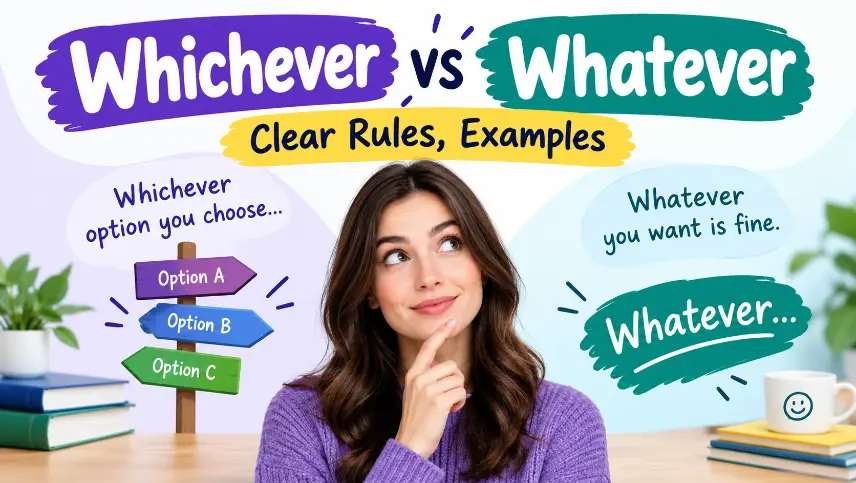
Whichever vs whatever looks simple on the surface, but it trips up even strong writers. The two words are related, both are flexible, and both can sound natural in conversation. That is exactly why confusion keeps spreading. One word points to a choice from a limited set, the other is broader and more open-ended. Once you see that difference, the whole topic gets much easier to control.
Here is the core idea. Whichever usually means “any one from these specific options.” Whatever usually means “anything at all,” “no matter what,” or “the thing that fits broadly.” The problem is that both can appear in similar sentences, which makes them feel interchangeable. They are not. In careful writing, precision matters, and the right choice changes the meaning.
The Core Rule Explained Simply: Strip the concept down to its absolute basics.
At the most basic level, whichever is selective. It works when there is a known set of options and you are choosing one from that set. Whatever is broader. It works when the exact option is unknown, unimportant, or unlimited. That difference is small in form, but large in meaning.
Whichever = a choice from a defined group
Use whichever when the sentence implies a menu of options, even if the options are not listed out loud. The listener should feel a boundary around the choices. You are not talking about every possible thing in the world, just the ones that fit the situation.
Example:
Take whichever seat is open.
The options are the available seats, not all seats everywhere.
Whatever = no fixed limit, or the exact item does not matter
Use whatever when the sentence feels open, broad, or unrestricted. It can mean “any amount,” “any thing,” “no matter what,” or “the thing that happens to be true.”
Example:
Take whatever you need.
The set is not narrowed down. The speaker is not limiting the choice to a small list.
Look at this:
Whichever belongs to a choice set.
Whatever belongs to a wide field.
That one distinction solves most errors.
Side-by-Side Comparison Table: Create a 4-column table comparing aspects of the topic
| Situation | Example | Meaning | Correct Usage |
| Choosing from known options | Pick whichever color you like. | Any one from the available colors | Whichever |
| Broad or open-ended choice | Take whatever color you want. | Any color at all, no limit implied | Whatever |
| Substituting a specific item | Use whichever tool works best. | One tool from the relevant set | Whichever |
| Speaking generally | Use whatever tool you have. | Any tool, the exact one does not matter | Whatever |
| Referring to unknown outcomes | Whatever happens, stay calm. | No matter what the outcome is | Whatever |
| Narrowing a decision | Whichever route is faster, take it. | One route from the candidate routes | Whichever |
Deep Dive into Category 1: Whichever
When whichever fits best
Whichever shines when you want to compare options or choose among alternatives. Even if the alternatives are implied rather than stated, they are still present in the meaning. That is why whichever often sounds like a decision word. It signals selection, ranking, or practical choice.
Use it when the sentence answers this question: “Which one from this group?”
Example:
Use whichever pen writes smoothly.
You are not asking for any pen in the universe. You are talking about the pens available right now.
Example:
Whichever team wins today will advance.
The choice is limited to the teams in that match.
The decision flavor behind whichever
This word often carries a subtle sense of confidence. The speaker is not deeply concerned about the exact item, only that it comes from the relevant set. That is why whichever works so well in instructions, comparisons, and recommendations.
Let’s make this concrete.
Whichever often appears with:
- best
- faster
- easier
- works
- fits
- comes first
These combinations point to a practical choice inside a limited group.
Example:
Choose whichever option is cheaper.
The options already exist, and the decision depends on the comparison.
Example:
Wear whichever jacket matches the dress.
The jackets are a known group, and one is selected from that group.
Quick Test for whichever
Use this quick check before you write it.
Ask yourself:
- Is there a limited set of options?
- Is the sentence about selecting one?
- Would “any one of these” fit the meaning?
- Does the sentence feel like a choice, not a broad statement?
If the answer is yes, whichever is probably right.
Here is another shortcut. Replace whichever with “any one that” in your head.
Example:
Whichever route is shortest, take it.
Any one that is shortest, take it.
That sounds natural, so whichever fits.
Patterns that reveal whichever
A few common sentence shapes show up again and again.
Whichever + noun + verb
Whichever answer is correct, explain why.
Whichever road looks safer, use it.
Whichever + clause + result
Whichever you prefer, I am fine with it.
Whichever wins the vote, we will support it.
Whichever + adjective comparison
Whichever is clearer, keep that version.
Whichever is more reliable, choose that tool.
These patterns all carry the same logic. There is a set, and one item is selected from it.
Deep Dive into Category 2: Whatever
When whatever fits best
Whatever is broader, looser, and more open. It can mean “anything,” “the thing that happens,” or “it does not matter which.” It often feels less restricted than whichever, and that wider feel is exactly why it works.
Use it when the sentence answers this question: “It does not matter what, exactly?”
Example:
Take whatever you need.
The speaker is not limiting the list of possible things.
Example:
Say whatever comes to mind.
The exact options are open, and nothing is being narrowed.
The broad meaning behind whatever
This word can do several jobs, which is part of the confusion. It may express:
- any thing
- any amount
- no matter what
- the thing that is not important to specify
Because of that flexibility, whatever often sounds less technical and more general than whichever.
Example:
Whatever happens, keep going.
This means no matter what situation arises.
Example:
Eat whatever you like.
This means the choice is open, not restricted to a small set.
The emotional tone of whatever
In conversation, whatever can sound casual, dismissive, or even irritated, depending on tone. That is another reason the word gets tricky. In neutral writing, the meaning is usually broad and open-ended. In spoken English, the tone can shift fast.
Example of neutral usage:
Use whatever materials are available.
Example of dismissive usage:
Whatever. I am done talking.
The second example is not about choice or freedom. It is about attitude. Context decides the meaning.
Patterns that reveal whatever
Whatever + noun
r Whatever reason you give, be honest.
Whatever route you take, plan ahead.
or Whatever + verb clause
Whatever you decide, tell me tonight.
Whatever they offer, check the details.
Whatever + noun phrase + may be
r Whatever the cause may be, we need a fix.
Whatever the outcome may be, we will adapt.
These patterns show whatever in its broadest role. It reaches beyond a closed set.
The Meaning Shift (or Nuance): Explain the subtle differences between the options
This is the part most people miss. The difference is not just grammar, it is scope.
Whichever narrows the world.
Whatever opens it up.
That means the same sentence can shift slightly depending on which word you use.
Compare these:
Whichever seat is free, take it.
This implies a few specific seats are available.
Whatever seat is free, take it.
This sounds a little looser, and in some contexts it can feel less natural because the sentence is trying to make a choice from a set, which is where whichever usually wins.
Now compare:
Whichever happens, stay calm.
This sounds off in standard usage because “happens” is not a clear choice from a set.
Whatever happens, stay calm.
This is the natural form, because it means no matter what event occurs.
That is the nuance in action. One word is about selection. The other is about all possibilities within a broad frame.
Why the Confusion Persists: Explain the core problem, education gaps, or evolving trends
People confuse whichever and whatever because both can follow similar structures and both are common in everyday English. The words also appear in informal speech, where exact distinctions are easier to ignore. Once a phrase sounds familiar, it gets repeated without much analysis.
Another reason is that English learners often see both words translated into the same word in another language. That hides the difference. The learner remembers the general idea, but not the boundary between closed choice and open possibility.
There is also a teaching gap. Many grammar explanations focus on rules in isolation, not on meaning range. But these words are easier to master when you think about what the writer is trying to do. Is the sentence pointing to a specific set? Or is it saying any outcome, any thing, any amount?
Once writers learn to ask that question, the confusion drops sharply.
Formal vs Casual Contexts: Explain how usage changes depending on the environment
In formal writing, the distinction matters more. Academic essays, business emails, editorial copy, and exam responses all reward precision. Using whichever when you mean whatever, or the reverse, can make a sentence feel muddy or slightly incorrect.
Example in formal writing:
Please select whichever option best fits the criteria.
This is strong because it clearly points to a defined group.
Example in formal writing:
Whatever the circumstances, the deadline remains unchanged.
This is strong because it means no matter what happens.
In casual speech, people blur the line more often. They use whichever word sounds natural in the moment. That is one reason the error survives. Conversation is forgiving. Editing is not.
Example in casual speech:
Take whichever you want.
Take whatever you want.
Both can work, but they do not mean exactly the same thing. The first feels more like a choice among options. The second feels more open and unrestricted.
That difference becomes important when the sentence carries legal, professional, or academic weight.
Case Studies / Pop Culture Examples: Provide real-world, academic, or cultural examples
You see this distinction all over real English.
In instructions, a phrase like “Use whichever file is updated” is common because there is usually a small set of candidate files. The writer is not speaking about all files in existence. The sentence is about one from a relevant group.
In customer service, a phrase like “Use whatever method is easiest for you” is common because the speaker wants flexibility. The exact method does not matter, only that it works.
In literature and film, whatever often appears in dramatic or emotional dialogue. A line like “Whatever happens next, we will face it together” sounds wide, resilient, and open to uncertainty. The word helps create a sense of scope and emotional range.
In everyday pop culture language, whatever can become a rhetorical brush-off. That usage is so common that the word now carries a strong tone in many conversations. It is less about grammar and more about attitude. That is why context matters so much.
Even in academic writing, the distinction shows up in careful phrasing. A sentence like “Whichever method yields the lowest error rate should be selected” is precise and testable. A sentence like “Whatever method is used, the sample size must be consistent” is broader and rule-based.
The same logic also appears in news writing, policy language, and research summaries. Precision is not decoration there, it is part of the meaning.
Advanced Scenarios & Flowchart: Provide a text-based decision flowchart to help the reader decide
When the sentence feels tricky, walk through a simple decision path.
Start here:
Is the sentence about choosing one item from a known group?
Yes, use **whichever**.
No, go to the next question.
Does the sentence mean “no matter what,” “anything,” or “the exact item does not matter”?
Yes, use **whatever**.
No, go to the next question.
Is the word introducing an open-ended situation, event, or outcome?
Yes, use **whatever**.
No, go to the next question.
Are you comparing several options and selecting the best one?
Yes, use **whichever**.
No, check the tone and revise the sentence.
Here is the deeper version.
If you can imagine a shortlist, think **whichever**.
If you can imagine unlimited possibilities, think **whatever**.
or if the sentence means “no matter what happens,” think **whatever**.
If the sentence means “any one of these choices,” think **whichever**.
That flow catches most real-world cases fast.
Quick Reference Table: A simple 2-column summary table for fast checking
| Word | Fast Rule |
| Whichever | Use for a choice from a limited set |
| Whatever | Use for open-ended, broad, or unlimited meaning |
| Whichever | Often fits comparisons, selection, and practical choice |
| Whatever | Often fits “no matter what,” “anything,” or general flexibility |
Common Mistakes That Lower Quality: List what even experienced people get wrong
One common mistake is using whichever in a sentence that really needs whatever because the meaning is broad, not selective. For example, “Whichever happens, stay calm” sounds unnatural in standard English. The intended meaning is whatever happens.
Another mistake is using whatever when the sentence clearly involves a small choice set. That can make the sentence vague. “Take whatever chair is open” may be fine in some casual settings, but “Take whichever chair is open” is often cleaner and more precise.
A third mistake is ignoring tone. In spoken English, whatever can sound dismissive. In writing, that same word may look neutral, but readers still carry the emotional shade with them. That is why context matters.
A fourth mistake is overthinking every sentence and forgetting the basic test. Ask: choice set or open field? If you skip that step, you are likely to guess instead of decide.
A fifth mistake is copying phrases from memory without checking the meaning. Fixed expressions like “whatever happens” and “whichever one you prefer” are common because they fit the rule. When you change them carelessly, the sentence can become awkward.
Memory Hacks That Actually Work: Actionable tricks to remember the rules
Use this memory trick: whichever = which one.
If your brain naturally wants to ask “which one from these?”, use whichever.
Use this second trick: whatever = anything goes.
If the meaning is broad, unrestricted, or open-ended, use whatever.
Use this third trick: whichever is for the shortlist.
If there is a shortlist, there is selection. Selection points to whichever.
Use this fourth trick: whatever is for the wide-open world.
If there is no fixed list, no fixed limit, and no need to narrow the field, whatever is usually right.
Here is a fast pair to remember:
Whichever = choose one.
Whatever = any thing, any way, no matter what.
Say that pair a few times and it sticks.
Why Precision Matters (SEO/Authority): Explain why getting this right builds credibility
Precision matters because readers notice clean, confident language even when they cannot explain why it feels better. Correct word choice makes writing easier to trust. It also makes your point faster to understand. That matters in SEO, where clarity supports engagement, and in authority writing, where credibility is built sentence by sentence.
Search engines do not reward awkward phrasing just because a keyword appears. Readers still have to stay with the page, and they stay longer when the writing feels accurate. Choosing whichever and whatever correctly helps your content sound natural, polished, and expert.
It also protects your meaning. In legal, academic, business, or educational writing, a small misuse can create confusion. If your audience has to pause and reinterpret a sentence, the message loses force. Precision reduces friction.
That is the larger lesson here. Good grammar is not about showing off. It is about making your meaning unmistakable.
A quick quiz: 5 to 8 fill in the blanks.
Fill in each blank with whichever or whatever.
- Choose ________ option works best for your schedule.
- ________ happens, we will handle it together.
- Use ________ tool you trust most.
- Take ________ seat is available near the window.
- ________ you decide, let me know before noon.
- Pick ________ answer seems most accurate.
- Eat ________ you want from the menu.
- ________ route is faster, follow that one.
Answers:
- whichever
- whatever
- whatever or whichever, depending on whether the tools are a broad set or a defined shortlist. In most standard sentence meanings, whichever is better if the tools are a known group.
- whichever
- whatever
- whichever
- whatever
- whichever
The key is not memorizing a single word list. It is understanding the meaning behind the sentence. If you see a choice from a set, think whichever. If you see broad openness or no matter what, think whatever.
Conclusion
Understanding whichever vs whatever is much easier once you focus on the meaning behind each word instead of memorizing grammar rules. Whichever is the right choice when you are selecting from a specific or limited group of options, while whatever works when the possibilities are broad, unrestricted, or unknown. That small distinction creates clearer, more accurate sentences in everyday conversations, professional communication, academic writing, and online content. The more you notice how these words function in real examples, the more natural the correct choice becomes. Rather than guessing, ask yourself whether you are making a selection from known options or referring to anything without limits. That simple habit eliminates most common mistakes.
Strong writing depends on precision, and choosing between whichever and whatever is a perfect example of how small word choices can have a big impact. Whether you are writing emails, blog posts, reports, essays, or website content, using the correct term helps readers understand your message instantly and improves your overall credibility. It also makes your writing sound more polished and confident. Keep practicing with real sentences, compare similar examples, and test yourself by identifying whether a sentence involves a limited choice or an open-ended possibility. With consistent practice, the distinction becomes automatic, allowing you to write naturally and accurately in every situation.
Frequently Asked Questions
Is whichever always used for limited choices?
Yes, in most standard English, whichever is used when choosing from a specific or implied set of options. The group does not always have to be listed explicitly, but it should exist within the context. If the sentence involves selecting one option from several available choices, whichever is almost always the correct word.
Can whatever replace whichever in casual conversation?
Sometimes it can, especially in informal speech where people often use the words more loosely. However, replacing whichever with whatever may make the sentence less precise or slightly change its meaning. In formal writing, academic work, and professional communication, it is best to keep the distinction clear.
Why is “Whatever happens” correct instead of “Whichever happens”?
The phrase “Whatever happens” means “no matter what happens.” It refers to every possible outcome rather than selecting one from a limited list. Since no defined set of events is being chosen from, whatever accurately expresses the broad, open-ended meaning intended by the speaker or writer.
Is whichever more formal than whatever?
Not necessarily. Both words are acceptable in formal English, but they serve different purposes. Whichever emphasizes choosing from available options, while whatever emphasizes flexibility or unlimited possibilities. Neither word is inherently more formal, but using the correct one improves the clarity and professionalism of your writing.
Can both words be correct in the same sentence?
Yes, there are situations where both are grammatically acceptable, but they create different meanings. Whichever suggests a limited selection, while whatever suggests a broader or unrestricted choice. Writers should consider the intended meaning carefully before deciding which word better communicates their message.
How can I quickly remember the difference?
A simple memory trick is to associate whichever with “which one?” and whatever with “anything.” If you can point to a defined group of options, choose whichever. If the possibilities are open or unlimited, choose whatever. This shortcut works for most everyday situations.
Are these words commonly confused by native English speakers?
Yes. Even native speakers occasionally mix them up, particularly in casual speech where precision is less important. Because the meanings overlap in certain contexts, many people rely on habit instead of grammar. Careful writers, however, distinguish between them to ensure their meaning remains clear and accurate.
Do grammar checkers always catch mistakes with these words?
No. Many grammar tools focus on spelling and sentence structure rather than subtle differences in meaning. A sentence using whatever instead of whichever may still appear grammatically correct even if it is less precise. Understanding the underlying rule yourself is the most reliable way to avoid mistakes.
Which word is better for SEO writing and professional content?
Neither word is better on its own. The best choice depends entirely on the intended meaning. Using whichever and whatever accurately improves readability, strengthens topical authority, and builds trust with readers. Clear, precise language also contributes to better user experience, which supports high-quality SEO content over time.

Ethan Lawson is a dedicated writer and English enthusiast who enjoys making language simple, practical, and easy to understand. At GrammarFixery, Ethan shares useful guidance on grammar, vocabulary, sentence structure, word meanings, and everyday English. His goal is to help readers write with greater clarity and confidence without making language feel complicated. Whether you are a student, professional, content creator, or English learner, Ethan provides clear tips and helpful examples to make every sentence stronger and easier to understand.