
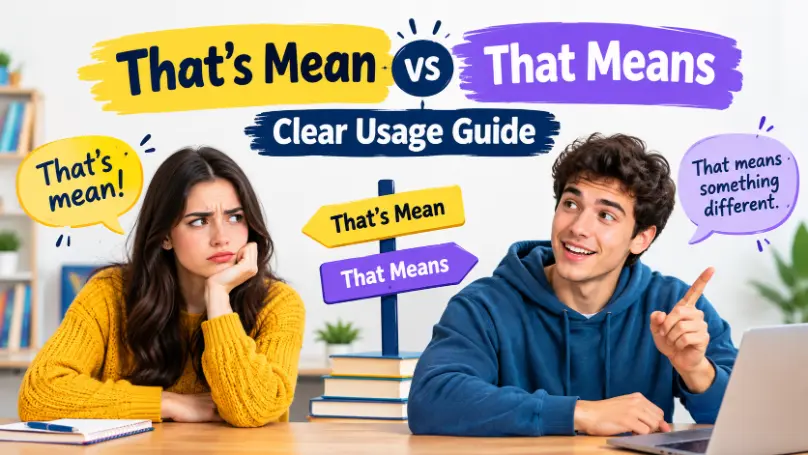
When people search thats mean vs that means, they are usually trying to solve one simple problem, which phrase is correct in a given sentence. The answer depends on grammar, meaning, and context. One version comments on behavior, the other introduces a conclusion or explanation. That small difference matters because it changes how your sentence sounds, how clearly your point lands, and how professional your writing feels.
Here is the fast rule. That means is the standard phrase when you want to explain a result, define a consequence, or show what something implies. That is mean is the full form when you are describing rude or unkind behavior. In casual speech, that’s mean often appears as a shortened version of that is mean. The confusion starts because both forms sound close, but they do not do the same job.
The Core Rule Explained Simply
Strip it down to the basics, and the difference becomes easy.
That means points forward to an explanation.
That is mean points to a judgment about behavior.
One phrase explains. The other critiques. That is the heart of the issue.
First side, a judgment about behavior
Use that’s mean when you mean that is mean, or in other words, something is unkind, unfair, or harsh. It is a description of attitude or behavior. The phrase usually responds to something someone said or did.
Example:
That joke was cruel, that’s mean.
This use is emotional and conversational. It tells the reader or listener that a line, action, or choice crossed a boundary.
Second side, a statement of meaning or consequence
Use that means when you want to show a result, interpretation, or conclusion. It connects an earlier idea to the next one.
Example:
The store closes at 6, that means we need to leave now.
This use is logical and explanatory. It helps the reader move from fact to consequence without losing the thread.
Side-by-Side Comparison Table
| Situation | Example | Meaning | Correct Usage |
| Describing rude behavior | “You laughed at her mistake, that’s mean.” | The action was unkind | That’s mean |
| Explaining a result | “The deadline moved up, that means less time.” | One fact creates a consequence | That means |
| Reacting emotionally | “Calling him that name, that’s mean.” | The speaker judges the action | That’s mean |
| Drawing a conclusion | “Traffic is heavy, that means we should leave early.” | A logical inference follows | That means |
Deep Dive into Category 1: That’s Mean
When people say that’s mean, they usually mean that is mean. The phrase is a direct reaction to something rude, insulting, unfair, or hurtful. It often appears in everyday conversation, especially when someone wants to call out bad behavior quickly.
When to use it
Use that’s mean when the sentence is about kindness or cruelty, not about explanation. It works well when you are reacting to a comment, a joke, a prank, or a decision that feels harsh.
Examples:
- “You hid her notebook? That’s mean.”
- “Making fun of his accent, that’s mean.”
- “That comment was unnecessary, that’s mean.”
Notice the pattern. The phrase is usually emotional. It does not solve a problem or create a conclusion. It judges the action itself.
What it really communicates
This phrase says more than “I disagree.” It says the behavior was morally or socially wrong, at least in the speaker’s view. That is why tone matters so much. That’s mean can sound playful among friends, but it can also sound serious if the situation is sensitive.
A child might say, “That’s mean,” after being teased.
An adult might say it after hearing a cutting remark.
A writer might use it in dialogue to make a character sound natural and immediate.
A quick test for that’s mean
Ask yourself this:
- Am I judging someone’s behavior?
- Am I saying it was unkind?
- Could I replace the phrase with “that is mean”?
If the answer is yes, that’s mean is the right choice.
Look at this:
“If you make fun of her grades, that’s mean.”
Now try the explanation test:
“If you make fun of her grades, that means.”
That second version is incomplete because it starts like an explanation but does not finish one. The meaning is wrong. The phrase changed jobs.
Common sentence patterns with that’s mean
You will often see that’s mean after:
- insults
- teasing
- unfair treatment
- sarcastic remarks
- hurtful actions
Examples:
- “Stealing his lunch? That’s mean.”
- “Telling her she failed on purpose? That’s mean.”
- “Leaving him out just to embarrass him? That’s mean.”
These sentences focus on the act itself. They are not describing logic. They are describing character or behavior.
Deep Dive into Category 2: That Means
That means is one of the most useful phrases in English because it connects ideas cleanly. It tells the reader that the second part follows from the first. You use it when you explain, infer, summarize, or translate a fact into a consequence.
When to use it
Use that means when you are building a logical bridge.
Examples:
- “The flight is delayed, that means we have extra time.”
- “He did not study, that means the test will be difficult.”
- “The store is closed, that means we need another plan.”
Each sentence moves from observation to result. That is the job of that means.
Why it is so common
This phrase appears in everyday speech, school writing, business writing, journalism, and academic explanation. It is simple, direct, and flexible. You can use it to interpret numbers, explain behavior, or spell out consequences.
Examples:
- “Sales dropped by 12 percent, that means revenue fell too.”
- “She missed the bus, that means she will be late.”
- “The evidence is weak, that means the argument is not strong enough.”
A quick test for that means
Ask yourself:
- Am I explaining a result?
- Am I drawing a conclusion?
- Could I replace it with “this shows that” or “therefore”?
If yes, that means is likely correct.
Look at this:
“The teacher canceled class, that means we can leave early.”
Now compare:
“The teacher canceled class, that’s mean.”
That second version does not work because the grammar is fine but the meaning is broken. It sounds like a judgment, not an explanation.
Common sentence patterns with that means
That means often follows:
- facts
- numbers
- actions
- conditions
- warnings
- predictions
Examples:
- “The package arrived early, that means I do not need to wait.”
- “The app is updating, that means it will restart soon.”
- “He apologized, that means he understands the problem.”
This phrase often appears after a comma, because it adds the next step in the thought.
The Meaning Shift
The subtle difference is not just grammar, it is purpose.
That’s mean is evaluative. It tells you how to feel about an action.
That means is explanatory. It tells you what follows from a fact.
One looks backward at behavior. The other looks forward to consequence.
That shift matters because readers subconsciously expect a phrase to match the job it is doing.
If you say:
“Taking her seat was rude, that’s mean.”
The sentence feels complete because the phrase agrees with the moral judgment.
If you say:
“Taking her seat was rude, that means.”
The sentence feels unfinished, because the phrase suggests a conclusion is coming, but no conclusion arrives.
Now flip it:
“The test is tomorrow, that means I should study tonight.”
This works because the sentence moves from fact to action.
“The test is tomorrow, that’s mean.”
This does not work, because tomorrow’s test is not a sign of rudeness. It is a fact with a consequence.
Why the Confusion Persists
The confusion keeps showing up for a few reasons.
First, English learners hear both phrases in casual speech, and the apostrophe in that’s makes them sound even closer. The ear hears one thing, the eye sees another, and the brain fills in the gap.
Second, people often type quickly. Autocorrect, texting habits, and informal writing can flatten the difference between that’s mean and that means. The result is a sentence that sounds okay at a glance but breaks under a closer look.
Third, many speakers learn phrases by sound before they learn the grammar behind them. That is normal. But it also means they may recognize the rhythm of a phrase without understanding its function.
Here is the deeper issue. English lets one small change in a phrase alter the entire meaning. A missing letter or a different contraction can switch a sentence from judgment to explanation. That is why thats mean vs that means remains a common search. People are not just asking about spelling. They are asking about function.
Formal vs Casual Contexts
Context changes everything.
In casual conversation, people shorten phrases freely. They say that’s mean when reacting to a rude joke, and nobody pauses to analyze the grammar. The phrase feels natural because it matches speech patterns.
In formal writing, precision matters more. If you are writing an essay, a report, a blog post, or a professional email, you need to make sure the phrase matches your intent exactly. If you mean explanation, use that means. If you mean a criticism of behavior, use that is mean or that’s mean depending on tone and style.
Here is the practical breakdown:
- In dialogue, that’s mean sounds natural and human.
- In informative writing, that means is clearer and safer.
- In academic or professional contexts, avoid ambiguity by writing the full form when needed.
Example in casual speech:
“You told her secret? That’s mean.”
Example in formal writing:
“The budget was cut, that means fewer resources for the project.”
The second sentence is clean, direct, and unmistakable.
Case Studies / Pop Culture Examples
You can see the difference in real-life communication all the time.
Classroom example
A student says, “He erased my work for fun.”
Another student replies, “That’s mean.”
This is a moral reaction. It is not an explanation. The speaker is judging the behavior.
Workplace example
A manager says, “The client changed the deadline, that means we need to revise the timeline.”
This is a business explanation. It turns one fact into an action item.
Movie or TV style dialogue
In scripts, writers often use that’s mean to reveal character. It makes dialogue sound immediate and emotionally honest.
Example:
“You told her she could not sit with us? That’s mean.”
The line tells us more about the speaker than about the logic of the scene. It creates personality.
News or commentary style example
A journalist or analyst may write:
“The country raised interest rates, that means borrowing will likely become more expensive.”
This is a cause-and-effect structure. It is built on interpretation.
Everyday social media example
On social platforms, people often write:
“Canceling plans last minute, that’s mean.”
or
“The concert sold out in two minutes, that means demand is huge.”
Both are correct in their own lane. The first judges behavior. The second explains a trend.
Advanced Scenarios & Flowchart
Sometimes the sentence is not obvious at first glance. Use the following decision path.
Start here:
Did you mean to describe something as unkind?
Yes, use that’s mean or that is mean.
No, go to the next step.
Are you explaining a consequence, result, or conclusion?
Yes, use that means.
No, go to the next step.
Are you trying to show what something implies?
Yes, use that means.
No, ask whether the sentence needs a judgment or an explanation.
Can the phrase be replaced with “that is mean”?
Yes, choose that’s mean.
Can the phrase be replaced with “therefore,” “so,” or “this shows”?
Yes, choose that means.
Here are three examples through the flowchart:
- “He ignored her message, ___ he was upset.”
This needs a conclusion. Use that means. - “He ignored her message, ___.”
If the point is that the behavior was rude, use that’s mean only if the sentence is reacting to a specific act. - “Mocking someone’s accent, ___.”
This is a judgment. Use that’s mean.
The flowchart works because it forces you to ask the real question, am I judging or explaining?
Quick Reference Table
| Phrase | Best Use |
| That’s mean | To judge rude, unkind, or unfair behavior |
| That means | To explain a result, conclusion, or implication |
Common Mistakes That Lower Quality
Even experienced writers make these errors.
1. Using that’s mean when they mean explanation
Example:
“The meeting was moved, that’s mean we start later.”
This is wrong because the sentence needs a consequence, not a moral judgment.
Correct:
“The meeting was moved, that means we start later.”
2. Using that means when they mean criticism
Example:
“You laughed at her failure, that means.”
This sounds incomplete and off because no explanation follows.
Correct:
“You laughed at her failure, that’s mean.”
3. Forgetting the apostrophe in that’s
If you write thats mean, the phrase looks informal and unpolished. In standard English, the contraction is that’s, with an apostrophe. That small mark matters.
4. Mixing tone and structure
A sentence can be grammatically possible but still sound wrong if the meaning is mismatched. Good writing is not just about words, it is about matching function to form.
5. Using one phrase in every context
Do not force that’s mean into explanatory writing, and do not force that means into emotional reaction. Let the sentence decide.
Memory Hacks That Actually Work
The easiest memory trick is this:
Mean with a judgment, means with a result.
That one-letter difference tells you a lot.
Try these shortcuts.
Hack 1: Think “kindness test”
If the sentence is about kindness, cruelty, or rudeness, use that’s mean.
If the sentence is about logic, consequence, or explanation, use that means.
Hack 2: Think “judge or connect”
That’s mean judges behavior.
That means connects ideas.
Hack 3: Swap in a full phrase
Replace that’s mean with that is mean.
Replace that means with this shows that or therefore.
If the swap works, you have your answer.
Hack 4: Picture two lanes
One lane is emotional, the other is logical.
That’s mean travels in the emotional lane.
That means travels in the logical lane.
Hack 5: Use the verb clue
Means is often followed by an explanation.
Mean is often used as an adjective-like description in the phrase that is mean.
This clue can help you remember the structure even when you are typing fast.
Why Precision Matters, SEO and Authority
Precision is not just a grammar concern. It affects credibility.
When you use that’s mean and that means correctly, your writing sounds sharper, cleaner, and more trustworthy. Readers notice when a sentence flows naturally. They also notice when a phrase feels off, even if they cannot name the mistake.
For SEO, clarity helps too. Search readers scan fast. They want answers that are simple, direct, and easy to trust. If your article clearly separates that’s mean from that means, it satisfies the reader faster and keeps them engaged longer.
Authority also depends on consistency. Writers who treat small grammar decisions carefully usually sound more reliable overall. That matters in blog posts, educational content, brand copy, and editorial writing.
In other words, getting this right is not a tiny detail. It is part of sounding informed.
A Quick Quiz
Fill in the blanks with that’s mean or that means.
- He copied her homework, __________.
- The train is delayed, __________ we will be late.
- Making fun of someone’s voice, __________.
- The store closed early, __________ we need another place.
- She called him names, __________.
- The weather is improving, __________ we can go बाहर?
No, use English here, the correct completion is __________. - You ruined his surprise, __________.
- The exam was canceled, __________ we have extra time to study.
Answers
- that’s mean
- that means
- that’s mean
- that means
- that’s mean
- that means
- that’s mean
- that means
The pattern is simple once you see it. That’s mean is for judgment. That means is for explanation. Keep that split in mind, and the phrase choice becomes automatic.
Conclusion
Choosing between that’s mean and that means is much easier once you understand the job each phrase performs. That’s mean expresses a judgment about someone’s behavior, attitude, or actions, while that means explains a consequence, interpretation, or logical conclusion. Although the two expressions sound similar in everyday conversation, they communicate completely different ideas. Mixing them up can confuse readers and weaken the clarity of your writing. Whether you are composing an email, writing a blog post, completing schoolwork, or simply chatting online, recognizing this distinction helps your sentences sound more natural, accurate, and professional. A small grammar choice often creates a big difference in how effectively your message is understood.
Strong writing is built on clear, precise language, and mastering small distinctions like that’s mean vs that means is part of becoming a confident communicator. Instead of memorizing random grammar rules, focus on the purpose of your sentence. If you are criticizing rude or unkind behavior, choose that’s mean. If you are explaining what something implies or what happens next, choose that means. With regular reading and writing, the correct choice will become instinctive. Paying attention to these details improves readability, strengthens credibility, and helps your content connect with readers, whether you are writing for school, work, SEO, or everyday communication.
Frequently Asked Questions
Is that’s mean grammatically correct?
Yes. That’s mean is grammatically correct because it is the contraction of that is mean. It is used to describe behavior, comments, or actions that are rude, unfair, or unkind. The phrase commonly appears in conversations and informal writing, but it is also acceptable in many forms of standard English when the context involves judging behavior.
When should I use that means instead of that’s mean?
Use that means whenever you want to explain a result, conclusion, implication, or definition. It connects one idea to another by showing what follows from a fact or situation. If your sentence answers the question “What does this imply?” rather than “Was this unkind?”, that means is the correct choice.
Why do people confuse that’s mean and that means?
The confusion happens because the two expressions sound very similar when spoken quickly. Many learners first hear these phrases in conversation before seeing them written. Since only one letter changes the spelling, people often type the wrong version, especially in text messages or casual online communication where speed matters more than careful proofreading.
Can I replace that’s mean with that is mean?
Absolutely. That’s is simply a contraction of that is, so replacing that’s mean with that is mean does not change the meaning. In formal writing, some writers prefer the expanded version for extra clarity, while contractions are perfectly natural in conversational and less formal contexts.
Is that means considered formal English?
Yes. That means is widely accepted in both formal and informal English. It appears frequently in academic papers, business reports, presentations, news articles, instructional content, and everyday conversation. Because it clearly introduces an explanation or consequence, it is one of the most useful linking phrases in English writing.
How can I quickly remember the difference?
A simple memory trick is to associate mean with kindness and means with meaning. If you are talking about someone being rude or unkind, choose that’s mean. If you are explaining what something indicates or what happens next, choose that means. This quick association works well in both speaking and writing.
Are these phrases interchangeable?
No. Although they sound alike, they serve different grammatical and communicative purposes. That’s mean evaluates behavior, while that means explains information or draws a conclusion. Replacing one with the other changes the meaning of the sentence and can make your writing confusing or grammatically awkward.
Is it acceptable to write thats mean without an apostrophe?
In standard English, no. The correct contraction is that’s, with an apostrophe replacing the missing letter in that is. Writing thats mean without the apostrophe is generally considered a spelling error, especially in professional, academic, and published writing.
Does using the correct phrase improve SEO content?
Yes. Correct grammar improves readability, user trust, and overall content quality, all of which contribute to a better user experience. While search engines primarily evaluate relevance and usefulness, readers are more likely to stay on a page, engage with the content, and view it as authoritative when grammar and word choice are accurate.

Noor Sullivan is a passionate writer and English enthusiast dedicated to making language easier to understand and use. At GrammarFixery, Noor creates clear, practical content covering grammar, vocabulary, word meanings, sentence structure, and everyday English. With a friendly and straightforward approach, Noor helps readers turn confusing language questions into useful answers. Whether you are a student, professional, writer, or English learner, Noor’s guides are designed to build confidence, improve writing, and make communicating ideas feel natural and effortless.