
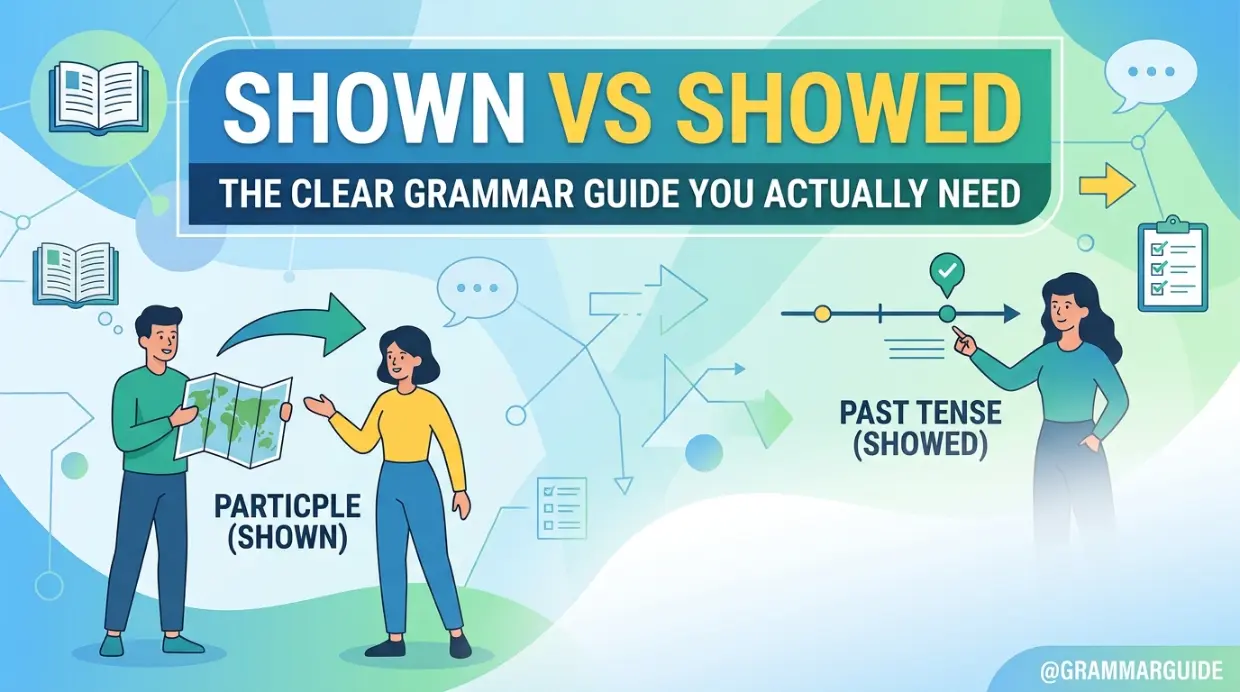
Shown vs showed is one of those grammar pairs that looks simple until you have to use it in a sentence. Then the doubt starts. Should you say “I showed him” or “I have shown him”? Should a report say “the data was shown” or “the data was showed”? The answer depends on tense, structure, and whether you need a simple past form or a past participle form.
Here is the good news, this rule is not complicated once you see the pattern. Showed is the regular past tense. Shown is the past participle. That means the two words do different jobs, and choosing the right one is mostly about recognizing the sentence frame. Once you master that, your writing sounds cleaner, more confident, and more professional.
The Core Rule Explained Simply
The core rule is easy to remember, shown and showed are not interchangeable in every sentence.
Showed is the simple past form of show. Use it when the action happened and finished in the past, and the sentence does not need an auxiliary verb like have, has, or had.
Shown is the past participle form of show. Use it with helping verbs such as have shown, has shown, had shown, or in passive structures such as was shown or has been shown.
Let’s make that even simpler.
Side 1, Showed
Use it when you are telling a straight past event. The action is complete, the sentence is direct, and no helper verb is needed.
Side 2, Shown
Use it when the sentence needs a perfect tense or passive voice. The word shown often works with another verb that carries the tense.
Look at this contrast:
- I showed the teacher my project yesterday.
- I have shown the teacher my project already.
Both are correct, but they do different jobs. The first is plain past tense. The second is present perfect, which connects the action to the present.
Side-by-Side Comparison Table
| Situation | Showed | Shown | Correct Use |
| Simple past action | I showed her the message. | I shown her the message. | Showed is correct |
| Present perfect | I have showed her the message. | I have shown her the message. | Shown is correct |
| Past perfect | I had showed him the chart. | I had shown him the chart. | Shown is correct |
| Passive voice | The results were showed to the class. | The results were shown to the class. | Shown is correct |
The pattern is consistent. If the verb stands alone in the past, choose showed. If the verb needs have, has, had, was, were, or been, choose shown.
Deep Dive into Category 1, Showed
When to use showed
Use showed when you are describing a completed action in the past. The sentence should feel direct and finished.
Examples:
- She showed me the new design.
- He showed up late to the meeting.
- They showed the guests around the house.
- The professor showed a slide during the lecture.
Notice the shape of those sentences. They are simple, clean, and complete. There is no need for a helper verb. The action happened in the past, and the sentence stands on its own.
Why showed sounds natural in simple past
English uses simple past for completed actions at a specific time in the past. Showed fits that pattern perfectly. If you can mentally add words like yesterday, last week, two minutes ago, or in 2023, there is a strong chance showed is the right choice.
Examples:
- I showed her the photos yesterday.
- The coach showed the team a new strategy last night.
- We showed our work at the science fair last month.
These all work because the action is clearly finished.
Quick Test for showed
Use this fast checklist:
- Is the sentence talking about a finished past action?
- Is there no have, has, had, was, were, or been before the verb?
- Could you replace it with another simple past verb like walked or opened?
If the answer is yes, showed is probably correct.
Common examples where showed wins
- He showed me the schedule.
- She showed no fear.
- The ad showed a clear message.
- The map showed the shortest route.
In each case, the verb tells you about a completed action or a direct result in the past.
A useful warning
People often write shown when they mean simple past because shown looks more formal. That is a trap. Formal does not mean correct in every sentence. Grammar still needs the right tense, and showed is the correct simple past form.
Deep Dive into Category 2, Shown
When to use shown
Use shown when the sentence needs a past participle. That usually means a helper verb is present.
Examples:
- I have shown him the report.
- She has shown great patience.
- They had shown interest before the offer changed.
- The issue was shown in the final chart.
The key idea is this, shown usually does not carry the tense by itself. It works with the rest of the verb phrase.
Why shown is so common in professional writing
Shown appears often in academic, business, and formal writing because those styles use passive voice and perfect tenses more often.
Examples:
- The study has shown promising results.
- The graph has shown a steady increase.
- The error was shown in the audit.
- The findings have shown a clear trend.
These sentences sound polished because shown fits the structure of formal explanation.
Patterns that help you spot shown
You will often see shown after these words:
- have shown
- has shown
- had shown
- was shown
- were shown
- been shown
Examples:
- The evidence has shown improvement.
- The document was shown to the committee.
- The method had shown weak results earlier.
If you see one of these helper forms, shown is the form you want.
A quick note on passive voice
Passive voice often sounds longer, but sometimes it is the best option. In passive sentences, shown is the natural choice.
- The results were shown to the jury.
- The figures were shown on the screen.
- The process was shown in the demonstration.
The subject receives the action instead of performing it. That structure needs the participle shown.
Quick Test for shown
Ask these questions:
- Is there a helper verb before the main verb?
- Is the sentence using present perfect, past perfect, or passive voice?
- Does the sentence sound incomplete without the helper verb?
If yes, shown is probably correct.
The Meaning Shift, or Nuance
The most important nuance is not meaning, it is grammar function. Both words come from the same base verb, show, and both refer to the act of making something visible, clear, or known. The real difference is how each word behaves inside the sentence.
Showed feels more direct. It pushes the action into the past and leaves it there.
Shown feels more connected. It links the action to another verb or to a result that matters now.
Compare these:
- I showed him the answer.
- I have shown him the answer.
The first is a simple report of what happened. The second suggests the action matters now, perhaps because the person knows the answer already or the result still stands.
Another subtle difference is style. Shown often feels slightly more formal, especially in business, academic, or analytical writing. But that formality only works when the grammar structure supports it.
Why the Confusion Persists
The confusion persists for three main reasons.
First, English verbs are irregular in a messy way. Some verbs have forms that look almost the same, while others change dramatically. Readers and writers then start guessing instead of applying a rule.
Second, many people hear shown in formal speech and assume it is simply the more advanced version of showed. That is not true. It is a different form with a different grammatical job.
Third, both words can appear in similar-looking sentences. That makes the mistake hard to catch.
For example:
- I showed him the map.
- I have shown him the map.
The subject, object, and meaning are similar, so the difference hides inside the verb phrase. That is why even experienced writers sometimes pause here.
Education gaps also matter. Grammar lessons often teach tense in separate boxes, simple past in one lesson, perfect tense in another, passive voice in another. When people write naturally, they have to connect all those lessons in real time. That is where mistakes happen.
Formal vs Casual Contexts
In casual conversation, people often focus on speed, not precision. They may say, “I showed him already” and move on. In everyday speech, that sounds normal because context carries the meaning.
In formal writing, precision matters much more. A resume, report, essay, or article needs the correct form because readers judge the writing by its grammar. That is where shown becomes especially important.
Casual context
- I showed my friend the meme.
- I showed him the route.
- I showed her the text.
These are ordinary, direct, and natural.
Formal context
- The analysis has shown a strong correlation.
- The evidence was shown in the appendix.
- The model has shown consistent performance.
These are more polished and structurally complex.
The rule does not change based on mood, but the level of attention does. Casual conversation allows more tolerance. Formal writing demands accuracy.
A practical distinction
When speaking casually, people often use shortened or simplified patterns. When writing professionally, the sentence must be grammatically complete. That means shown becomes more visible in professional work, while showed remains common in direct narration.
Case Studies, Real-World and Cultural Examples
Academic writing
Academic papers often use shown because they describe research findings, passive procedures, and completed effects.
Example:
- The experiment has shown that the treatment improves accuracy.
This is a textbook present perfect structure. Shown is required because has is doing the tense work.
Business writing
Business reports also favor shown when presenting results.
Example:
- The dashboard has shown steady growth for three quarters.
That sentence sounds credible and precise. If you wrote has showed, it would sound wrong to most native speakers.
News writing
Journalistic writing may use both forms, depending on the sentence.
- The report showed a drop in sales.
- The data has shown a decline across several regions.
The first is a past event. The second connects the finding to the present report.
Pop culture and everyday speech
In movies, interviews, and social media, you hear a wide range of grammar choices. Characters may say things that sound natural in speech but would be weaker in print.
Example:
- He showed me the photo.
That sounds normal in conversation.
But in polished writing, you may also see:
- The photo was shown to the detective.
That version sounds more formal and controlled.
A memorable example from storytelling
A narrator might say:
- The hero showed courage in battle.
- The hero has shown courage throughout the story.
The first is a single past event. The second suggests a continuing record. Same verb family, different time frame.
Advanced Scenarios & Flowchart
The tricky cases happen when the sentence seems to allow either word at first glance. Here is a simple decision flowchart to help.
Is the sentence using have, has, had, was, were, or been?
Yes, use **shown**
No, keep going
Is the verb describing a plain completed action in the past?
Yes, use **showed**
No, keep going
Is the sentence passive, meaning something is being presented or revealed to someone?
Yes, use **shown**
No, keep going
Is the sentence a simple past narration with no helper verb?
Yes, use **showed**
No, rewrite the sentence structure
Advanced example 1
- The teacher showed the class the experiment.
This is simple past, so showed is correct.
Advanced example 2
- The experiment has shown unexpected results.
This is present perfect, so shown is correct.
Advanced example 3
- The results were shown on the screen.
This is passive voice, so shown is correct.
Advanced example 4
- She had shown remarkable patience before the decision.
This is past perfect, so shown is correct.
A useful rewrite trick
If you are unsure, rebuild the sentence using a different verb. For example, replace show with tell or explain and see whether the structure feels like simple past or perfect/passive.
- I told him yesterday.
- I have told him already.
That same logic maps back to:
- I showed him yesterday.
- I have shown him already.
Quick Reference Table
| Need | Use This |
| Simple past, finished action | showed |
| Present perfect | shown |
| Past perfect | shown |
| Passive voice | shown |
| Direct narration | showed |
| Formal result statement | shown |
This table is the fastest way to check yourself. When in doubt, look for a helper verb. If one exists, shown is usually the answer. If not, showed is usually the answer.
Common Mistakes That Lower Quality
Even strong writers make these errors.
1. Using shown as simple past
Wrong: I shown him the email.
Correct: I showed him the email.
This is the most common mistake. Shown cannot stand alone as the simple past in standard English.
2. Using showed after has or have
Wrong: The research has showed improvement.
Correct: The research has shown improvement.
The helper verb has needs the past participle, not the simple past.
3. Mixing passive voice with the wrong form
Wrong: The presentation was showed to the board.
Correct: The presentation was shown to the board.
Passive structures almost always need shown here.
4. Overthinking formality
Wrong assumption: Shown always sounds smarter.
Reality: Shown is only right when the grammar structure calls for it.
5. Forgetting the sentence frame
Sometimes writers stare at the word alone instead of the whole sentence. That leads to errors. Always check the full pattern, not just the verb.
Memory Hacks That Actually Work
Hack 1, think showed = alone
If show is standing by itself in the past, use showed.
Hack 2, think shown = helper verb
If you see have, has, had, was, were, or been, use shown.
Hack 3, use the told / told test
Because tell works similarly in many sentence patterns, you can compare:
- I told him.
- I have told him.
Then map that structure back to showed and shown.
Hack 4, ask whether the action is finished or connected
If the sentence is just reporting a finished event, pick showed.
If the sentence is linking the action to a result, choose shown.
Hack 5, remember the phrase “has shown”
This is one of the most common and useful pairings in English. Once you see it enough times, the pattern sticks.
Why Precision Matters, SEO and Authority
Precision matters because grammar shapes trust. Readers notice when a sentence feels off, even if they cannot explain why. In professional writing, those tiny signals affect how credible you sound.
For SEO, clarity helps readability. Search engines reward content that is easy to understand, well structured, and useful to readers. Correct grammar supports that because it reduces friction and keeps the page looking polished.
For authority, the details matter even more. If an article about grammar cannot use shown and showed correctly, readers may doubt the rest of the advice. That is why precision is not just a technical concern, it is a credibility signal.
This is especially true in educational content, business blogs, legal-adjacent writing, and academic summaries. Strong grammar shows that the writer understands both the rule and the audience.
When you use shown and showed correctly, you communicate three things at once:
- You understand the tense.
- You understand sentence structure.
- You respect the reader’s attention.
That is a small detail with a big reputation effect.
A quick quiz, fill in the blanks
Fill in the blanks
- I ______ the manager the final draft yesterday.
- The report has ______ a steady increase in traffic.
- The painting was ______ to the class during the lesson.
- She ______ no fear during the presentation.
- They had ______ the results before the deadline.
- The chart ______ the difference very clearly.
Answer key
- showed
- shown
- shown
- showed
- shown
- showed
Extra challenge
Rewrite these with the correct form:
- The team has showed strong progress.
- The document was showed to the editor.
- I shown her the shortcut.
Correct versions:
- The team has shown strong progress.
- The document was shown to the editor.
- I showed her the shortcut.
Conclusion
Choosing between shown vs showed becomes much easier once you understand the role each word plays in a sentence. Showed is the simple past tense of show, making it the correct choice when you’re describing a completed action in the past without a helping verb. Shown, on the other hand, is the past participle, so it belongs in perfect tenses such as has shown, have shown, and had shown, as well as in passive constructions like was shown. Rather than memorizing dozens of examples, focus on recognizing the sentence pattern. If there’s no helping verb, showed is usually correct. If the sentence includes a helping verb or passive voice, shown is almost always the right answer. This simple approach eliminates most grammar mistakes before they happen.
Mastering this distinction improves more than just grammar. It makes your writing clearer, more professional, and more credible, whether you’re drafting an email, preparing a business report, writing academic content, or creating SEO articles. Readers naturally trust writing that follows standard English conventions, and search engines also favor content that is accurate and easy to understand. Whenever you’re uncertain, pause for a moment and identify the verb structure instead of guessing based on what “sounds right.” With regular practice, the choice between shown and showed becomes automatic, allowing you to write with greater confidence and precision in every situation.
FAQs
Is showed a real word?
Yes, showed is absolutely a real and correct English word. It is the simple past tense of the verb show. You use it when describing an action that happened and finished in the past without a helping verb. For example, “She showed me the new design yesterday” is grammatically correct and follows standard English usage.
Is shown grammatically correct?
Yes, shown is also grammatically correct, but it serves a different purpose than showed. It is the past participle of show and should be used with helping verbs like has, have, had, or in passive voice. For example, “The results have shown improvement” and “The report was shown to the committee” are both correct.
Why can’t I say “I have showed”?
The phrase “I have showed” is considered incorrect in standard English because the verb have requires the past participle, not the simple past tense. Since shown is the past participle of show, the correct sentence is “I have shown.” This rule applies to all perfect tenses, including has shown and had shown.
When should I use showed instead of shown?
Use showed whenever the sentence is in the simple past tense and does not include a helping verb. It works best for describing completed actions in the past. Examples include “He showed me the report” and “They showed great enthusiasm during the presentation.” If a helping verb appears, you’ll usually need shown instead.
Can shown ever be used without a helping verb?
In standard English grammar, shown normally requires a helping verb because it functions as a past participle. Sentences like “I shown her the document” are incorrect. Instead, write “I showed her the document” or “I have shown her the document,” depending on the intended tense and meaning.
Which form is more common in professional writing?
Both forms appear frequently, but shown is especially common in professional, academic, and scientific writing because those styles often use perfect tenses and passive voice. For example, phrases such as “research has shown” or “the evidence was shown” appear regularly in reports and scholarly articles. Showed remains common in straightforward narratives and past events.
Does the meaning change between showed and shown?
The basic meaning of the verb remains the same, which is to make something visible or known. The difference lies in the grammar, not the definition. Showed expresses a completed past action, while shown works within verb phrases that connect the action to another time frame or grammatical structure, such as perfect tenses or passive voice.
How can I quickly remember the difference?
A simple memory trick is to associate showed with standing alone and shown with having a helper. If the verb appears by itself in a past-tense sentence, use showed. If it’s paired with words like has, have, had, was, or were, choose shown. This shortcut works for the vast majority of everyday writing situations.
Are mistakes with shown and showed common among native speakers?
Yes, these mistakes are surprisingly common because English has many irregular verb forms. Native speakers sometimes choose the wrong form in casual speech or informal writing, especially when speaking quickly. However, in formal writing, business communication, and academic work, using shown and showed correctly helps maintain clarity, professionalism, and credibility.

Amelia Brooks is a dedicated writer and English enthusiast who believes great writing starts with clear, simple language. At GrammarFixery, Amelia creates helpful content that makes grammar, vocabulary, sentence structure, and everyday English easier to understand. Her goal is to turn confusing language rules into practical guidance readers can use with confidence. From students and professionals to English learners and content creators, Amelia helps readers strengthen their writing, communicate their ideas clearly, and feel more confident with every word they write.