
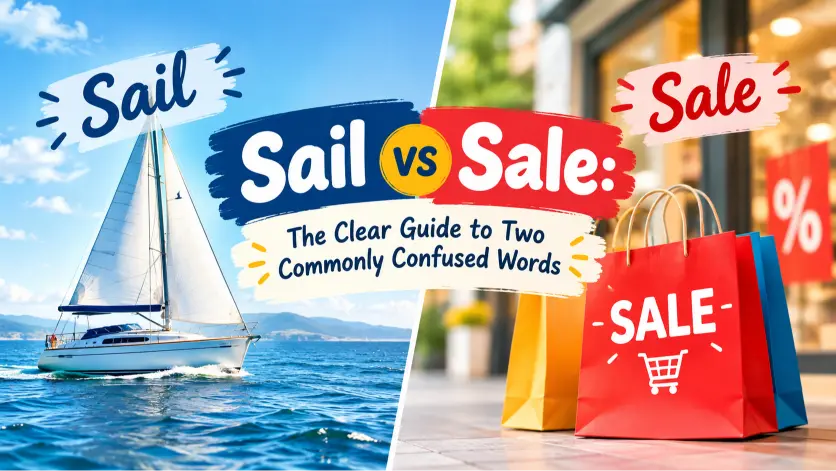
Sail vs sale is a classic spelling confusion, but the meaning difference is huge. One word belongs to the sea, travel, and movement, while the other belongs to pricing, discounts, and buying. Mix them up, and your sentence can look careless fast.
Here is the simple truth. Sail is usually a noun or verb connected to a boat, ship, or the act of traveling on water or through the air. Sale is a noun connected to an item being sold, a discount event, or the act of selling. They sound almost identical, but they live in completely different meaning zones.
That is why this topic matters. In writing, spelling accuracy affects readability, trust, and authority. SEO, clear wording helps search engines and readers understand your content without hesitation. Everyday writing, getting sail vs sale right prevents embarrassment and confusion.
The Core Rule Explained Simply
The core rule is very easy.
Sail = boat, ocean, travel, or motion.
Sale = buying, selling, discount, or commerce.
Think of sail as the word that moves through water. Think of sale as the word that moves money. One is about navigation. The other is about transactions.
Side 1: Sail
Use sail when you mean to travel on water in a boat or ship. It can also mean to glide smoothly or move effortlessly in a broader sense. The word often appears in phrases like set sail, sail across, or sail away.
Side 2: Sale
Use sale when you mean something is being offered for purchase. It also refers to a discount event, such as a store sale. You will see it in phrases like for sale, on sale, or sale price.
The Fastest Way to Tell Them Apart
Ask this simple question:
Am I talking about a boat or movement? Use sail.
Am I talking about a product or price? Use sale.
That one check solves most mistakes instantly.
Side-by-Side Comparison Table
| Situation | Example | Meaning | Correct Usage |
| Water travel | The boat will sail tomorrow. | Move on water | Sail |
| Discount event | The shoes are on sale. | Reduced price | Sale |
| Departure phrase | We will set sail at dawn. | Begin a sea journey | Sail |
| Selling phrase | The house is for sale. | Available to buy | Sale |
This comparison shows the real divide. Sail describes motion or travel. Sale describes commerce, ownership, and pricing. The spelling changes because the meaning changes completely.
Deep Dive into Category 1: Sail
Sail is the word you want when the idea is connected to water, boats, ships, or smooth movement. It is one of those words that feels almost visual. You can picture the boat cutting through the waves, the wind filling the sail, and the journey beginning.
When to Use Sail
Use sail when the subject is a boat, ship, crew, voyage, or ocean route. It also works as a verb for moving gracefully or easily. In casual speech, people may also use it metaphorically, as in “She sailed through the exam” or “The project sailed ahead.”
Here are some correct examples:
- The crew will sail across the Atlantic.
- We watched the ship sail into the harbor.
- They plan to sail around the islands next summer.
- She sailed through her final interview.
Notice the pattern. In every case, the core idea is movement. That movement may be literal, like a ship on water, or figurative, like an easy success.
Common Forms of Sail
The word sail can appear in several forms:
- sail as a base verb or noun
- sails for plural noun or third-person verb form
- sailing for ongoing action
- sailed for past tense
Examples:
- The sail caught the wind.
- The boat sails at noon.
- They are sailing now.
- The captain sailed yesterday.
This is useful because the spelling stays the same root, even when the grammar changes.
Quick Test for Sail
Use this checklist before choosing the word:
- Is the sentence about water travel?
- Is there a boat, ship, ocean, or harbor?
- Is the word describing smooth movement?
- Could the sentence fit the idea of gliding, cruising, or traveling?
If you answered yes to any of these, sail is probably correct.
Sail in Figurative Language
Sail is not only for ships. Writers use it for motion that feels easy, fast, or graceful.
Examples:
- The answer sailed into my mind.
- The team sailed to victory.
- The news sailed through the office quickly.
This figurative use matters because it broadens the word beyond literal boats. Still, the central idea remains the same, smooth movement.
Deep Dive into Category 2: Sale
Sale is the word you want when the focus is commerce. It means something is being sold, offered for purchase, or marked down in price. This word appears everywhere in business, retail, real estate, and everyday shopping.
When to Use Sale
Use sale when you are talking about:
- a discount
- an item available to buy
- the process of selling
- a market or business transaction
Examples:
- The jacket is on sale this week.
- That car is for sale.
- The store is having a weekend sale.
- The sale of the property closed yesterday.
Here, the meaning is economic, not nautical. There is no boat, no wind, and no journey on water. There is simply a product, price, or transaction.
Common Forms and Phrases with Sale
Some of the most common phrases include:
- for sale
- on sale
- sale price
- final sale
- sale event
Examples:
- The phone is for sale.
- These sneakers are on sale.
- The sale price is lower than the original price.
- All clearance items are final sale.
These phrases are common in ads, store signs, and online listings. That is why sale shows up so often in commercial writing.
Quick Test for Sale
Use this checklist before choosing the word:
- Is the sentence about buying or selling?
- Is there a price, discount, or store?
- Is something being offered to customers?
- Does the sentence involve a transaction?
If yes, sale is the right choice.
Sale in Business and Marketing
In business writing, sale can refer to the act of selling itself, not just a discount.
Examples:
- The sale of the startup took six months.
- Sales increased after the campaign.
- The sale was finalized on Friday.
This is where many learners get tripped up. The word can mean a discount event, but it can also mean the broader act of selling. The meaning stays commercial either way.
The Meaning Shift
The difference between sail and sale is small in spelling but massive in meaning.
The first letter changes the whole idea.
Sail points to motion, travel, and water.
Sale points to commerce, value, and purchasing.
That tiny vowel shift changes the world of the sentence. One word belongs to ships and skies. The other belongs to stores and receipts. This is why spelling matters so much in English. A single letter can redirect the reader completely.
Look at these examples:
- The yacht will sail at sunset.
- The yacht is for sale at sunset.
Those sentences are not interchangeable. The first means the boat will depart. The second means the boat can be bought. Same object, totally different message.
Why the Confusion Persists
The confusion persists for a few reasons.
First, the words are homophones in many accents. They sound nearly the same when spoken aloud. That means the listener has to rely on context, while the writer has to rely on spelling.
Second, both words are short and common. Short words are easy to mix up because the eye reads them quickly. A writer may type the wrong one without noticing.
Third, context sometimes moves fast. In shopping ads, people see sale all the time. In stories and travel writing, people see sail all the time. Because both words are familiar, the brain can autopilot and choose the wrong spelling.
Fourth, spelling checkers do not always catch it. Both words are real words, so a spell checker may not flag the mistake. That makes the error sneakier than a simple typo.
Formal vs Casual Contexts
The difference between sail and sale matters in both formal and casual writing, but the consequences are not equal.
In formal writing, precision is essential. Business proposals, academic essays, reports, and articles need the correct word every time. A wrong choice can make the text look rushed or poorly edited. For example, writing “The house is for sail” in a property listing would immediately undermine credibility.
In casual writing, the stakes are lower, but the mistake still looks odd. A text message, social caption, or quick note can survive minor errors, yet readers still notice them. “Everything is on sail” may be understandable from context, but it still feels wrong.
Here is the practical rule:
- Use sail in travel, maritime, or metaphorical movement contexts.
- Use sale in shopping, pricing, and business contexts.
That rule works in formal and casual settings alike. The difference is not style, it is meaning.
Case Studies / Pop Culture Examples
Real-world examples make the distinction easier to remember.
Case Study 1: Travel and Adventure Writing
Travel blogs often use sail to create movement and mood.
Example:
“We will sail from the coast at sunrise.”
This sentence gives the reader a sense of departure, atmosphere, and motion. It would be wrong to write sale here because the idea is not commerce.
Case Study 2: Retail Advertising
Stores use sale to attract buyers.
Example:
“Summer sale starts Friday.”
This is classic retail language. The word signals discounts, urgency, and shopping behavior. Writing sail here would make the message confusing and absurd.
Case Study 3: Pop Culture and Music
Songs, films, and literature often use sail symbolically. The word can suggest freedom, escape, journey, or emotional movement. For example, a phrase like “sail away” carries a dreamy, open-ended feeling.
By contrast, sale appears in stories when money, business, or market pressure matters. A novel may describe a fire sale, a closing sale, or the sale of a family home. That language creates a very different emotional tone.
Case Study 4: Academic and Professional Writing
In academic or professional settings, exact word choice matters even more. A researcher writing about maritime history would use sail repeatedly. A business analyst discussing retail performance would use sale repeatedly.
That separation is helpful. The right word signals that the writer understands the topic at a technical level.
Advanced Scenarios & Flowchart
Sometimes the choice is not obvious at first glance. That is when a mental flowchart helps.
Read the sentence and ask these questions in order:
Is the sentence about a boat, ship, or ocean journey?
If yes, use sail.
not, is it about pricing, selling, or a store promotion?
If yes, use sale.
not, is the word being used figuratively for smooth movement?
If yes, use sail.
not, is the sentence about ownership transfer or business transaction?
If yes, use sale.
none of these fit, reread the sentence and identify the main action.
The word should match that action exactly.
This flowchart works because it reduces the decision to one central question: movement or commerce?
Trickier Examples
- The boat is on sale.
Correct. The boat is available to buy. - The boat will sail tomorrow.
Correct. The boat will depart. - The sailor watched the sale from the dock.
Maybe correct only if a shop or transaction is nearby, but it sounds odd. The context would need to clearly justify it. - The sale caught the wind.
Incorrect. A transaction cannot catch the wind, but a sail can.
These examples show why context matters. The wrong word often creates an image that collapses the sentence.
Quick Reference Table
| Word | Fast Reminder |
| Sail | Boat, water, travel, glide |
| Sale | Selling, buying, discount, price |
This table is the fastest possible check. When in doubt, think sea for sail and store for sale.
Common Mistakes That Lower Quality
Even experienced writers make these mistakes.
- Writing “for sail” instead of “for sale”
- Writing “on sail” instead of “on sale”
- Using sale when describing a ship’s departure
- Using sail when talking about discounts or retail
- Relying only on sound, not meaning
- Missing the error because both words are real spellings
- Overusing the words without checking context
- Confusing figurative use of sail with literal boat language
These errors lower the quality of the writing because they interrupt trust. Readers may understand the intended meaning, but they still notice the mistake.
Memory Hacks That Actually Work
A good memory trick should be fast and visual.
Hack 1: Sail has an A for ocean
Think of sail and imagine A for Atlantic or A for anchor. That helps connect the word to water and boats.
Hack 2: Sale has an E for expense
Think of sale and connect it to expenses, exchanges, and earnings. That keeps the word tied to money.
Hack 3: Sail goes with ships
If you can picture a ship, sail is probably the word you need.
Hack 4: Sale goes with signs
If you can picture a store sign, sale is probably the word you need.
Hack 5: Ask what is moving
Is the object moving across water? That is sail.
Is the item moving from seller to buyer? That is sale.
That mental split is simple, and it works.
Why Precision Matters (SEO/Authority)
Precision matters because language builds credibility.
In SEO, readers scan quickly. They reward content that is clear, accurate, and easy to trust. A page that handles sail vs sale correctly signals attention to detail. That improves readability, and readability supports stronger engagement.
In authority writing, small errors can have a big effect. A single wrong word in a headline, product listing, or guide can make the entire page feel less professional. Readers may not analyze the mistake consciously, but they feel the drop in quality immediately.
Precision also helps search intent. Someone searching for sale wants shopping or pricing information. Someone searching for sail wants boat-related or travel-related information. Using the wrong word can weaken clarity and make content harder to match with the reader’s goal.
That is why correct spelling is not just grammar. It is part of brand trust, reader confidence, and content quality.
A Quick Quiz
Fill in the blanks with sail or sale.
- The cruise ship will ______ at dawn.
- The store is having a summer ______.
- The house is for ______.
- The captain helped the crew ______ through the storm.
- That jacket is on ______ this weekend.
- The boat’s ______ were full of wind.
- The project seemed to ______ through approval.
Answer Key
- sail
- sale
- sale
- sail
- sale
- sails
- sail
The quiz works because it forces you to connect the word to the right meaning. If you see boats, wind, or travel, think sail. If you see price tags, discounts, or buying, think sale. That is the whole rule, and once you know it, the confusion disappears fast.
Conclusion
Understanding sail vs sale becomes much easier once you connect each word to its core meaning instead of relying on pronunciation. Sail belongs to the world of boats, ships, journeys, wind, and smooth movement, while sale belongs to shopping, business, pricing, and transactions. Although the two words sound almost identical in many accents, they are never interchangeable because they represent completely different ideas. Building the habit of checking the context before writing will help you avoid one of the most common spelling mistakes in English. Whether you are writing an email, a blog post, a product listing, or an academic paper, using the correct word immediately makes your writing clearer, more professional, and more trustworthy.
The best way to master sail vs sale is through repetition and simple memory cues. Picture a ship crossing the ocean whenever you see sail, and picture a store advertising discounts whenever you see sale. This visual association makes the distinction almost automatic. As your vocabulary grows, you’ll notice that accurate word choice improves not only grammar but also communication, credibility, and SEO performance. Readers appreciate precise language because it reduces confusion and builds confidence in the information they are reading. Master this pair once, and you’ll rarely hesitate over sail and sale again.
Frequently Asked Questions
Is “sail” ever used to mean buying or selling?
No. Sail is never used to describe buying, selling, or discounts. It refers to a boat’s movement, the fabric attached to a mast, or figurative smooth progress. If your sentence involves commerce, pricing, or ownership transfer, the correct word is always sale, not sail.
What does “sale” mean in English?
Sale is a noun that refers to the act of selling something, a discounted shopping event, or an item being available for purchase. Common phrases include for sale, on sale, and sale price. Every meaning of sale relates to business or commerce.
Why do people confuse sail and sale?
People confuse sail and sale because they are homophones in many English accents, meaning they sound almost identical when spoken. Since both are correctly spelled English words, spell checkers often fail to catch the mistake, making context the only reliable way to choose the correct spelling.
How can I remember the difference between sail and sale?
A simple memory trick is to connect sail with the sea and sale with the store. If you imagine a ship moving across water, use sail. If you imagine price tags, shopping carts, or discounts, use sale. This visual association is easy to remember and highly effective.
Can “sail” be used figuratively?
Yes. Sail is often used figuratively to describe doing something easily or moving smoothly through a situation. For example, someone can sail through an exam or sail into the finals. Even in figurative uses, the idea of effortless movement remains central to the meaning.
What are the most common phrases with “sale”?
Some of the most common expressions include for sale, on sale, garage sale, clearance sale, flash sale, sale price, and final sale. Each phrase relates to purchasing, selling, discounts, or commercial transactions rather than travel or transportation.
Is “for sail” ever correct?
Usually, no. The phrase for sail is almost always a spelling mistake. The correct phrase is for sale, which means an item is available to purchase. The only time for sail could appear is in a very unusual context discussing equipment or materials intended for sailing, not standard English usage.
Do search engines care about using sail and sale correctly?
Yes. Search engines aim to match content with user intent, and correct word choice helps achieve that. A page about sale should focus on shopping or business, while a page about sail should relate to boating or navigation. Accurate spelling also improves readability, user trust, and overall content quality.
Can both words appear in the same sentence?
Absolutely. Since the words have different meanings, they can naturally appear together. For example: “The yacht is for sale, but it will sail one final time before the ownership changes.” In this sentence, sale refers to the transaction, while sail refers to the boat’s movement.
Which word is more common in everyday writing?
It depends on the context. In retail, marketing, and business writing, sale appears far more frequently because it relates to products and commerce. In travel writing, maritime history, sailing sports, and nautical discussions, sail is more common. The correct choice always depends on the meaning of the sentence, not on which word is generally used more often.

Noor Sullivan is a passionate writer and English enthusiast dedicated to making language easier to understand and use. At GrammarFixery, Noor creates clear, practical content covering grammar, vocabulary, word meanings, sentence structure, and everyday English. With a friendly and straightforward approach, Noor helps readers turn confusing language questions into useful answers. Whether you are a student, professional, writer, or English learner, Noor’s guides are designed to build confidence, improve writing, and make communicating ideas feel natural and effortless.