
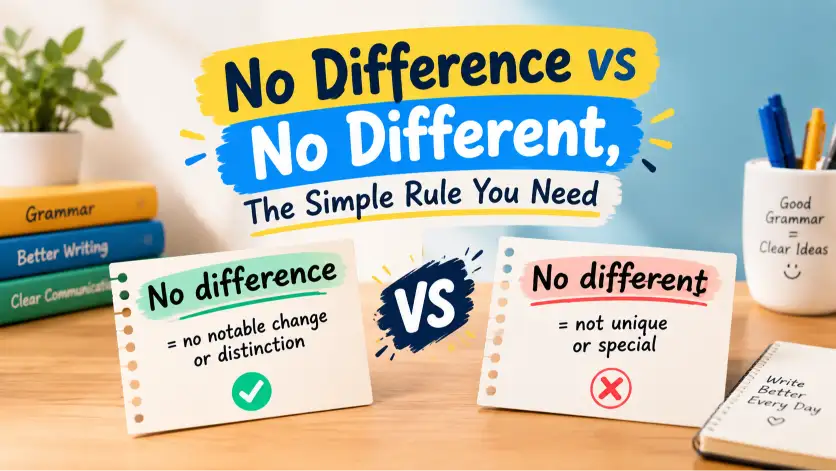
Getting no difference vs no different right is not about memorizing a random grammar trick. It is about knowing what each phrase is actually doing in the sentence. One is a noun phrase, the other is an adjective phrase. That sounds small, but it changes everything.
Here is the good news, the rule is simple once you see the pattern. No difference usually names the absence of a distinction. No different usually describes something as not being different from something else. That tiny shift explains most of the confusion.
Look at this carefully. If you can replace the phrase with “no distinction”, you are usually in no difference territory. If you can replace it with “not different” or “not unlike”, you are usually in no different territory. That is the core move.
The Core Rule Explained Simply
Strip it down to basics.
No difference talks about a thing, a result, or a gap that does not exist. It behaves like a noun phrase. You use it when the sentence is pointing to the absence of a distinction between two items, choices, outcomes, or groups.
No different behaves like a description. It works after a linking verb such as is, are, was, or were. It usually needs a comparison to make the meaning complete. It does not usually stand alone as neatly as no difference does.
Here is the simplest way to remember it.
If you are naming the absence, use no difference.
If you are describing a subject, use no different.
Side 1, No difference
This side is about the result, the outcome, or the fact that two things match in effect. It answers the question, “What is there between them?” The answer is, there is no difference.
Side 2, No different
This side is about a property or state. It answers the question, “What is it like?” The answer is, it is no different from something else.
The quickest shortcut
Say the sentence out loud and test the structure. If the phrase could be swapped with no distinction, choose no difference. If the phrase could be swapped with not different, choose no different.
Side-by-Side Comparison Table
| Situation | Example | Meaning | Correct Usage |
| Stating an absence of distinction | There is no difference between the two plans. | The plans are effectively the same. | No difference |
| Describing a subject as unchanged | This version is no different from the original. | It is not unlike the original. | No different |
| Comparing outcomes | In practice, there is no difference in results. | The result does not change. | No difference |
| Using a linking verb | Her opinion is no different today. | Her opinion has not changed. | No different |
Let’s make this concrete.
When the sentence points to the thing itself, no difference is usually cleaner. When the sentence attaches a quality to a subject, no different fits the grammar better. The table above shows the pattern in real use, not just in theory.
Deep Dive into Category 1, No Difference
This is the phrase you use when the idea is the absence of distinction. It is direct, strong, and easy to understand. In many contexts, it is the safest and most natural choice.
When to use no difference
Use it when you are talking about identical outcomes, equal value, or the same effect. You are not describing a thing as a quality. You are saying that a separation does not exist.
Examples:
- There is no difference between the two options.
- I noticed no difference in the final score.
- For most users, there is no difference in performance.
- The test found no difference between the groups.
Why it works
The phrase works because difference is a noun. You can count, measure, deny, or discuss a difference. That gives the sentence a clear object. You are not floating in adjective land. You are naming a fact.
What it often replaces
You can often mentally replace it with:
- no distinction
- no gap
- no variation
- the same result
If the replacement sounds natural, no difference is probably the right choice.
Quick Test for no difference
Use this checklist.
- Can I say no distinction instead?
- Am I talking about a result, comparison, or gap?
- Is the sentence naming a fact, not describing a subject?
- Would the sentence still make sense without a linking verb?
If you answered yes to most of these, go with no difference.
Clear examples in context
Look at the tone shift.
- There is no difference in quality.
This is direct and factual. - We found no difference after the update.
This sounds practical and measurable. - For me, there is no difference between the two brands.
This sounds personal but still precise. - There was no difference in the report’s conclusion.
This sounds formal and analytical.
The phrase is especially strong in writing where clarity matters. Reports, essays, academic work, and SEO content often prefer no difference when the goal is to state a comparison result cleanly.
Common patterns with no difference
You will often see it in these structures:
- There is no difference between X and Y
- I noticed no difference in X
- The study showed no difference between X and Y
- There was no difference after X
These are stable patterns because the noun phrase is carrying the meaning. That makes the sentence easy to read and hard to misread.
Deep Dive into Category 2, No Different
Now look at the second phrase.
No different is a description. It does not simply name the absence of a difference, it says that something is not different from something else. That means it usually needs a comparator to finish the thought.
When to use no different
Use it after a linking verb when describing a subject.
Examples:
- This policy is no different from the old one.
- Her answer was no different from mine.
- The new version is no different in practice.
- His approach is no different now.
Why it works
The phrase behaves like an adjective phrase. It modifies the subject through a linking verb. That is why the sentence often needs a comparison phrase such as from, than, or an implied comparison in context.
The core idea is simple, the subject is being described as not different.
What it often replaces
You can often think of it as:
- not different
- unchanged
- similar
- the same in effect
That mental swap helps a lot. If not different sounds natural in your sentence, no different is usually the right fit.
Quick Test for no different
Use this checklist.
- Is the phrase following is, are, was, or were?
- Am I describing a subject rather than naming a fact?
- Can I replace it with not different?
- Is there a comparison to another thing?
If yes, no different is probably correct.
Clear examples in context
See how the sentence structure matters.
- The final result is no different from before.
- His reaction was no different from what I expected.
- My schedule is no different today.
- Their method is no different in theory.
These sentences are describing a state. That is the real job of no different. It acts like a description, not a standalone comparison noun.
Common patterns with no different
You will often find:
- X is no different from Y
- X was no different than Y
- X seems no different
- X feels no different
Notice the linking verb. That is the sign. If the sentence is built around a subject being described, no different has a strong chance of being the right choice.
The Meaning Shift, or Nuance
The subtle difference is not about drama, it is about grammar and focus.
No difference focuses on the fact of sameness. It says the distinction does not exist. The sentence points to the gap, then closes it.
No different focuses on the state of the subject. It says the subject is not altered, not changed, or not unlike another thing. The sentence points to the subject, then describes it.
Here is the nuance in simple terms.
- There is no difference between them sounds like a conclusion.
- They are no different from each other sounds like a description.
Both can communicate similarity, but they do it from different angles. One names the absence of difference. The other describes the thing as not different.
That is why the choice matters in polished writing. It changes emphasis, rhythm, and precision.
Why the Confusion Persists
This confusion survives because English lets similar meanings wear different grammar clothes.
First, the meanings are close. Both phrases point to similarity, sameness, or a lack of change. That makes them feel interchangeable to many writers.
Second, spoken English often blurs the structure. In conversation, people shorten, skip, and compress ideas. A sentence like “It is no different” can sound close to “There is no difference” even though the grammar is different.
Third, learners are often taught to chase meaning before structure. That works for basic communication, but it creates trouble in editing. When the words sound similar, people stop checking whether the phrase is acting like a noun or an adjective.
Look at this:
- No difference = a noun idea
- No different = an adjective idea
That is the real reason the mix-up persists. The meanings overlap, but the grammar does not.
Formal vs Casual Contexts
Context changes the best choice.
In formal writing, no difference is often the cleaner and more direct phrase when you are reporting results or comparisons. It sounds structured and evidence-based. Research writing, business writing, and academic writing often benefit from that clarity.
In casual conversation, no different is very common. It sounds natural when you are describing how something feels or how a subject compares to another. People use it comfortably in everyday speech.
Here is the practical pattern.
Formal tone
- There is no difference between the two methods.
- The data showed no difference in response.
- We found no difference in the final outcome.
Casual tone
- This phone is no different from the last one.
- My day is no different from yesterday.
- His excuse sounds no different to me.
Neither phrase is “wrong” by default. The question is which one fits the structure and tone better. Formal writing tends to reward precision, and no difference often gives you that. Casual writing often favors flow, and no different can sound more conversational.
Case Studies, Academic, and Pop Culture Examples
Real-world usage makes the contrast easier to see.
Academic style
In a research paper, a writer might say, “The study found no difference between the treatment and control groups.” That is crisp, measurable, and neutral. The phrase reports the outcome.
A less likely but still possible version would be, “The treatment group was no different from the control group.” That works too, but it shifts the focus toward the group itself as the described subject.
Business writing
A product team might write, “We observed no difference in conversion after the redesign.” That sentence speaks the language of results. It is specific and efficient.
A more descriptive version could be, “The new layout is no different from the old one in practice.” That sounds closer to an internal review or a product note.
Everyday speech
A person might say, “This restaurant is no different from the one next door.” That is a natural spoken sentence. The subject is being described.
Another person might say, “Honestly, there is no difference to me.” That sounds like a conclusion or personal judgment. The phrase names the absence of distinction.
Pop culture style
A critic might say, “The sequel is no different from the first film in all the ways that matter.” That creates a descriptive judgment.
Another critic might say, “There is no difference in the formula.” That sounds more analytical and compact.
The pattern holds across contexts. When the sentence is reporting a finding, no difference feels strong. When the sentence is describing a subject, no different feels natural.
Advanced Scenarios and Flowchart
Some sentences are trickier because they hide the comparison.
Use this decision path.
Start here,
Ask yourself, am I naming the absence of a distinction?
If yes, use no difference.
If not, ask, am I describing a subject as not changed or not unlike something else?
If yes, use no different.
If still unsure, check the verb.
- If the sentence uses is, are, was, or were to describe the subject, no different may fit better.
- If the sentence states a finding, result, or comparison outcome, no difference may fit better.
Now check the replacement test.
- Can you swap in no distinction?
If yes, choose no difference. - Can you swap in not different?
If yes, choose no different.
Here is the flow in plain text.
If the sentence is about a result,
then choose no difference.
If the sentence is about a subject’s state,
then choose no different.
If the phrase follows a linking verb,
then test no different first.
If the phrase names the gap itself,
then test no difference first.
If both seem possible,
choose the version that makes the sentence tighter and more natural.
That is the advanced move. You are not guessing, you are reading the grammar.
Quick Reference Table
| Phrase | Best Use |
| No difference | Use when you are naming the absence of a distinction. |
| No different | Use when you are describing something as not different from something else. |
Keep this table in mind when editing. It is the fastest way to avoid a sloppy choice.
Common Mistakes That Lower Quality
Even experienced writers make these mistakes.
1. Using no different without a comparison
Saying “There is no different” is usually wrong because different is not being used as a noun. The phrase needs the right structure.
2. Using no difference when the sentence needs a description
If the sentence is “This version is no difference”, the grammar is off. You need “This version is no different.”
3. Forgetting the linking verb
No different usually needs a verb like is or was. Without it, the phrase can feel incomplete.
4. Mixing the phrase with vague comparisons
Sentences like “It is no different” can be fine, but if the comparison is unclear, the reader may need more context. Add from what or from which version when needed.
5. Overcorrecting a natural sentence
Some writers try to replace every no different with no difference. That can make sentences stiff or wrong. The goal is not to force one phrase everywhere. The goal is to match the grammar.
6. Making the sentence sound like a slogan instead of a fact
In professional writing, precision matters. A vague line like “There is no difference” can be too broad if you do not specify what is being compared. Add detail whenever possible.
Memory Hacks That Actually Work
Use short tricks that stick.
Hack 1, noun vs description
Think:
- No difference = noun
- No different = description
That one split solves most cases.
Hack 2, the replacement test
Try these swaps:
- No difference → no distinction
- No different → not different
Use the one that fits.
Hack 3, the verb clue
If you see a linking verb, check no different first.
If you see a result or finding, check no difference first.
Hack 4, the report trick
If you are writing a report, study, review, or summary, no difference often feels more factual.
Hack 5, the mirror trick
Ask, “Am I describing the subject, or am I naming the gap?”
Describing the subject leads to no different.
Naming the gap leads to no difference.
Hack 6, say it in plain English
Before you write, translate the sentence into simple language.
- No difference = there is no distinction
- No different = it is not different
The plain-English version often reveals the right structure instantly.
Why Precision Matters, SEO, and Authority
Precision is not just a grammar issue, it is a credibility issue.
When you use no difference vs no different correctly, readers trust your writing faster. Clean grammar signals control. It tells the reader that you understand both the meaning and the structure. That matters in blogs, academic work, brand content, and editorial writing.
For SEO, precision improves readability. Search engines reward content that feels clear, organized, and useful. Readers stay longer when the writing is easy to scan and easy to trust. When your phrase choices are sharp, the whole article feels more authoritative.
This also matters for brand voice. If your content says “There is no difference” where “It is no different” is needed, the sentence can feel awkward. Awkward phrasing weakens the message. Strong phrasing strengthens it.
Here is the bigger point. Grammar is not about being fussy. Grammar is about making meaning obvious. In that sense, choosing the right phrase is a form of respect for the reader.
A Quick Quiz
Fill in the blanks with no difference or no different.
- There is ______ between the two versions.
- This policy is ______ from the previous one.
- We found ______ in the final scores.
- My opinion is ______ today than it was yesterday.
- In practice, there is ______ between the two methods.
- Her response was ______ from mine.
- The results show ______ after the update.
- The new design is ______ in function.
Answer key
- no difference
- no different
- no difference
- no different
- no difference
- no different
- no difference
- no different
Use the key, then read the sentence again. The structure should feel obvious now. If the phrase names the absence of distinction, reach for no difference. If it describes a subject as not different, reach for no different. That is the rule, and it holds up in real writing.
Conclusion
Choosing between no difference and no different becomes much easier once you understand the role each phrase plays in a sentence. No difference is used when you are referring to the absence of a distinction, result, or measurable change, while no different is used to describe a person, object, or situation as being similar to something else. Although both expressions communicate the idea of similarity, they are not grammatically interchangeable. Paying attention to whether your sentence requires a noun phrase or an adjective phrase will help you make the correct choice every time. This simple distinction can instantly improve the clarity, professionalism, and accuracy of your writing, whether you are creating blog posts, academic papers, emails, business reports, or everyday messages.
Mastering no difference vs no different is about more than avoiding grammar mistakes. It demonstrates precision, strengthens your communication, and builds trust with readers. Strong writers understand that small wording choices often have a big impact on readability and authority. By using the replacement tests, grammar checks, and memory techniques covered in this guide, you can confidently choose the correct expression in almost any situation. With consistent practice, the distinction becomes second nature, allowing you to write naturally while maintaining a polished and credible style that both readers and search engines appreciate.
FAQs
Is no difference grammatically correct?
Yes, no difference is completely grammatically correct. It functions as a noun phrase that refers to the absence of a distinction between two or more things. It commonly appears in sentences such as “There is no difference between the two products.” This structure is widely accepted in formal writing, academic papers, business communication, and everyday English because it clearly expresses that no meaningful distinction exists.
When should I use no different?
Use no different when you are describing a subject as being similar to another person, object, or situation. It usually follows a linking verb such as is, are, was, or were and is often followed by from or than. For example, “The updated policy is no different from the previous version.” Here, the phrase describes the policy rather than naming the absence of a difference.
Can no difference and no different mean the same thing?
In many situations, both expressions communicate the idea of similarity, but they do so in different grammatical ways. No difference focuses on the lack of distinction itself, while no different focuses on describing a subject as similar. Because their grammatical roles differ, they cannot always replace one another without changing the sentence structure.
Which phrase is more common in formal writing?
In formal and academic writing, no difference is generally more common because it directly states findings, comparisons, and measurable outcomes. Researchers, journalists, and professionals frequently use it in reports and studies. No different also appears in formal writing, but it is typically used when describing a subject rather than presenting a factual comparison.
Is it wrong to say there is no different?
Yes, in most cases this construction is grammatically incorrect because different is an adjective, not a noun. The sentence should normally be “There is no difference.” If you want to use no different, you need a subject followed by a linking verb, such as “The result is no different from before.”
How can I quickly remember the difference?
A simple trick is to remember that difference is a noun and different is an adjective. If your sentence is naming the absence of a distinction, choose no difference. If it is describing a person or thing as similar to another, choose no different. This quick grammar check solves most usage problems immediately.
Do native English speakers confuse these phrases?
Yes, even native speakers occasionally mix them up because both phrases express similar meanings. In casual conversation, the intended meaning is often understood from context, but in professional or academic writing, choosing the correct expression makes the sentence clearer and more polished. Understanding the grammar behind each phrase helps eliminate this common mistake.
Can I use no different without saying from?
Sometimes, yes. If the comparison is already clear from the surrounding context, from may be omitted. For example, “Things are no different today.” However, when the comparison is not obvious, including from makes the sentence clearer and avoids ambiguity for the reader.
Which expression is better for SEO content?
Neither expression is universally better. The best choice depends on the sentence you are writing. SEO content performs best when it uses natural, grammatically correct language that readers easily understand. Using no difference when referring to comparisons and no different when describing similarities improves readability, credibility, and user experience, all of which support high-quality SEO writing.
Can I replace no different with the same?
In many situations, yes, but not always. The same and no different often express similar ideas, yet they may create slightly different emphasis depending on the sentence. No different highlights the absence of change or distinction, while the same simply states equality. Choosing the better option depends on the tone, context, and sentence structure.

Alex Turner is a passionate writer and language enthusiast dedicated to helping readers communicate with clarity and confidence. Through GrammarFixery, Alex shares practical guidance on grammar, word usage, sentence structure, writing style, and everyday English. His writing focuses on making confusing language rules simple, useful, and easy to apply. Whether you are a student, professional, content creator, or English learner, Alex’s goal is to help you write naturally, avoid common mistakes, and express your ideas with greater confidence.