
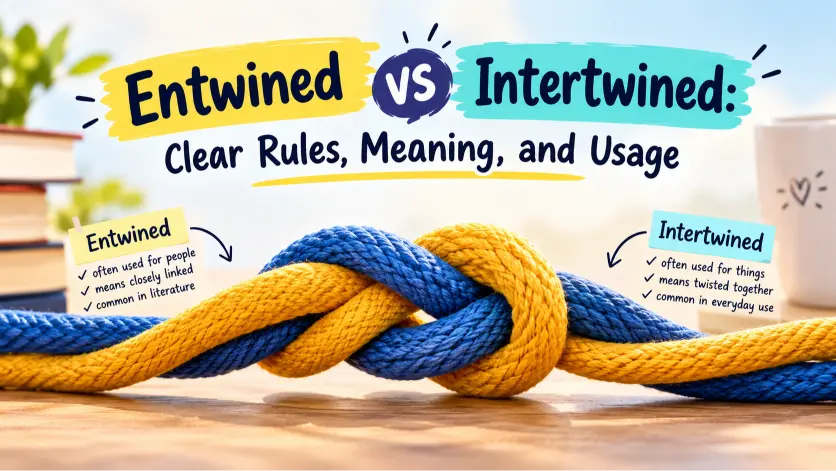
The difference between entwined vs intertwined looks small at first glance, but it matters more than most writers think. Both words suggest things that are woven together, connected, or difficult to separate. Still, the tone, image, and usual context are not exactly the same. That is why choosing the right one can instantly sharpen your writing.
Here’s the simple truth: entwined often feels softer, more graceful, and more intimate, while intertwined usually feels more complex, more technical, or more layered. In casual writing, people mix them freely. In precise writing, the distinction can add real clarity. Word choice is not just decoration, it shapes meaning.
Look at this carefully. If two hands are wrapped around each other, entwined often sounds natural. If two systems, histories, or ideas are deeply connected, intertwined usually fits better. That basic contrast will carry you through most real-world examples. The rest of this guide makes it concrete.
The Core Rule Explained Simply
The core rule is easy: use entwined when you want a more graceful, physical, or emotional image, and use intertwined when you want a more complicated, structural, or abstract connection. Both words mean “twisted together” in some form. The difference is mainly about feeling, shape, and context.
Think of entwined as the softer word. It often suggests something wrapped around something else in a close, elegant way. Vines, fingers, hair, hearts, and limbs are common settings for it. The image is often intimate or decorative.
Think of intertwined as the broader word. It often points to threads, systems, histories, responsibilities, or events that are so connected that you cannot easily separate them. The image can still be physical, but it usually carries more complexity. That is why it shows up so often in analytical writing.
Entwined is usually more graceful
Entwined creates a picture of gentle wrapping. It often feels smooth, poetic, and visual. You may see it in romance writing, nature descriptions, or emotional scenes. It suggests closeness without sounding overly technical.
Intertwined is usually more complex
Intertwined suggests that two things are not just touching, they are mixed together in a way that affects both of them. This makes it useful for topics like economics, politics, identity, family history, or plot structure. It sounds a little more analytical and a little less decorative.
Side-by-Side Comparison Table
| Situation | Best Choice | Meaning | Correct Usage |
| Two hands wrapped together | Entwined | Close, graceful, intimate | Their fingers were entwined. |
| Vines around a fence | Entwined | Natural, soft, visual | The vines were entwined around the railing. |
| Family history and politics | Intertwined | Deeply connected, layered | Their family history was intertwined with national events. |
| Two business systems affecting each other | Intertwined | Complex and inseparable | The two markets are intertwined. |
Deep Dive into Category 1: Entwined
Entwined works best when the image feels close, elegant, or physically wrapped. It is the more poetic option in many cases. Writers often use it when they want the reader to see movement, contact, and tenderness. It can also make abstract writing feel more human.
This word often appears in romance, nature, and descriptive prose. A pair of arms can be entwined. Two trees may have entwined branches. A necklace may rest on a neck in a way that feels almost entwined with the skin or the collar. The word brings a sense of shape and softness.
It is also common when the connection feels personal. For example, “their lives were entwined” sounds emotional and intimate. The phrase does not just mean “connected.” It suggests relationship, closeness, and shared experience. That is why the word often feels warmer than intertwined.
When entwined sounds best
Use entwined when the scene is physical, graceful, or emotionally close. If the image could be described with a hand, a vine, a ribbon, or a strand of hair, this word is a strong candidate. It fits best when the bond is visible and elegant rather than complicated and abstract.
Examples:
- The dancer’s hands were entwined above her head.
- Ivy was entwined around the old stone wall.
- Their fingers stayed entwined throughout the walk.
- Her memories of home were entwined with the scent of rain.
These examples all have one thing in common: the connection feels smooth and intimate. The word carries a visual curve.
Quick Test for entwined
Ask yourself these questions:
- Is the connection physical or easy to picture?
- Does it feel graceful, tender, or poetic?
- Would a reader imagine two things wrapped around each other?
- Is the tone more emotional than analytical?
If the answer is yes to most of these, entwined is probably the better choice. It is the word you reach for when the image matters as much as the meaning.
Deep Dive into Category 2: Intertwined
Intertwined works best when the connection is complex, layered, or difficult to separate. It is often the more analytical word. It does not have to be cold or technical, but it usually signals a deeper mesh of influences, causes, or structures. That makes it especially useful in explanation and argument.
This word appears often in essays, journalism, and academic writing. You may talk about intertwined histories, intertwined economies, intertwined identities, or intertwined themes in a novel. In each case, the point is not just that two things touch. The point is that they shape each other.
It can still describe a physical image, but that image often feels more tangled than graceful. Threads in fabric may be intertwined. Roots may be intertwined underground. Two plotlines may be intertwined throughout a book. The word suggests structure and complexity.
When intertwined sounds best
Use intertwined when the relationship is layered, mutual, or hard to separate. It works well when one thing affects another in a lasting way. It also works well when the writer wants to stress complexity more than beauty.
Examples:
- The company’s success was intertwined with global supply chains.
- Her personal beliefs were intertwined with her childhood experiences.
- The novel’s two storylines became intertwined by the final chapter.
- Art, politics, and identity are often intertwined in public debate.
These examples all show something beyond simple contact. They show interaction, dependence, and overlap.
Pattern to remember
A useful pattern is this: if the sentence could include words like complex, layered, mixed, connected, or inseparable, intertwined is probably doing the right job. It is the word of systems, networks, and ideas that do not sit neatly apart.
The Meaning Shift
The meaning shift between the two words is subtle but important. Entwined leans toward shape and closeness. Intertwined leans toward complexity and mutual influence. Both can describe things that are literally twisted together, but they do not create the same feeling.
In many cases, the difference is not about dictionary definition alone. It is about what your reader senses. Entwined feels more visual and intimate. Intertwined feels more conceptual and elaborate. That shift can change the mood of an entire sentence.
Here is the easiest way to see it. A pair of lovers may have lives that are intertwined, but their hands may be entwined. A story’s themes may be intertwined, but vines on a gate may be entwined. The words can overlap, but the best choice depends on the texture of the sentence.
Why the Confusion Persists
The confusion persists because the words are close cousins. They share the idea of twisting together. They also appear in the same kinds of sentences often enough to blur the line. For many speakers, both words sound natural in many contexts, so instinct rather than rule takes over.
Another reason is modern writing habits. Informal online writing often prefers the word that feels strongest in the moment, not the one that is most precise. As a result, writers may use entwined and intertwined as near-synonyms. That is not always wrong, but it can make writing less sharp.
Education also plays a role. Many grammar lessons focus on “correct or incorrect” more than nuance. But this pair is not mainly about strict right and wrong. It is about tone, visuality, and depth. That is why skilled writers pay attention to context, not just dictionary entries.
Formal vs Casual Contexts
In casual writing, the two words are often treated as interchangeable. A social caption, a personal essay, or a poetic line can use either word without causing much trouble. Readers usually focus on the overall image rather than the tiny distinction.
In formal writing, the difference matters more. An academic paper, news article, legal explanation, or business report benefits from the more exact word. If the connection is complicated or systemic, intertwined usually sounds more professional. If the description is physical and elegant, entwined may still be perfectly appropriate, especially in literary or reflective prose.
Look at the setting. In a romance novel, “their fingers were entwined” feels natural and stylish. In a sociology essay, “their identities are intertwined with migration patterns” sounds more precise. The audience and purpose shape the best choice.
Case Studies / Pop Culture Examples
Literature gives a clear view of the difference. Writers often use entwined for imagery involving nature, touch, and emotion. A poem may describe branches, arms, or hearts as entwined because the word adds elegance. It makes the sentence feel soft and visual.
By contrast, journalists and critics often use intertwined when discussing plot, history, or influence. A film may have intertwined timelines. A political drama may show intertwined corruption and ambition. The word helps the writer emphasize that several forces are working together.
Pop culture also uses the contrast well. A love song may talk about “entwined souls” to signal intimacy and romance. A documentary may discuss “intertwined causes” to signal complexity and analysis. The same basic idea, connectedness, becomes different depending on the setting.
Here’s a practical way to see it:
- A wedding image tends to favor entwined.
- A history documentary tends to favor intertwined.
- A nature poem may use either, but entwined often feels prettier.
- A policy analysis almost always prefers intertwined.
Advanced Scenarios and Flowchart
Sometimes the choice is not obvious. That is normal. When both words seem possible, run the sentence through a quick decision path. Start with the image, then move to the tone, then decide whether the connection is simple or layered.
If the connection is physical, ask whether the image is graceful or tangled. If it is graceful, entwined usually fits. Or If it is tangled, messy, or structurally complex, intertwined is safer. If the connection is abstract, ask whether the point is closeness or complexity. That usually settles it.
Indented flowchart:
- Start
- Is the connection physical and easy to picture?
- Yes
- Does it feel graceful, tender, or poetic?
- Yes, use entwined
- No, if it feels tangled or complicated, use intertwined
- Does it feel graceful, tender, or poetic?
- No
- Is the connection abstract, layered, or system-based?
- Yes, use intertwined
- No
- If the sentence is emotional or intimate, use entwined
- If the sentence is analytical, use intertwined
- Is the connection abstract, layered, or system-based?
- Yes
- Is the connection physical and easy to picture?
One more shortcut helps. If you can replace the sentence with “wrapped together” and still keep the feeling, entwined may work. If you need “deeply connected in a complicated way,” intertwined is usually better. That simple check handles most edge cases.
Quick Reference Table
| Need | Best Pick |
| Soft, graceful, poetic image | Entwined |
| Physical closeness | Entwined |
| Complex relationship | Intertwined |
| Abstract or analytical writing | Intertwined |
| Romance or intimacy | Entwined |
| Systems, histories, or themes | Intertwined |
Common Mistakes That Lower Quality
One common mistake is treating the two words as perfectly identical in every sentence. They are close, but not identical. When writers ignore nuance, the sentence can feel flat. The reader may not notice a grammatical error, but they often feel a weaker image.
Another mistake is choosing entwined in a sentence that clearly needs analytical depth. For example, “The economy and climate policy are entwined” is not wrong, but intertwined may sound stronger because the relationship is structural and complex. The wrong tone can make a serious sentence feel too decorative.
A third mistake is overusing intertwined in romantic or poetic prose. It can sound a bit heavy when a gentler word would do. If the sentence is about hands, vines, or hearts, entwined often creates a better emotional rhythm. Precision includes tone, not just definition.
A final mistake is mixing the two without checking the surrounding words. The surrounding verbs, nouns, and adjectives shape the choice. A soft description pairs naturally with entwined. A layered explanation pairs naturally with intertwined.
Memory Hacks That Actually Work
Use a simple image trick. Entwined contains twine, which helps you think of things wrapped together in a graceful way. Picture vines, ribbons, fingers, or hair. The word feels like a curve.
Now think of intertwined as “twined together in a more involved way.” The extra inter- gives it a broader, more connected feeling. Picture systems, histories, or threads crossing over one another. The word feels like a network.
Another trick is to match the tone to the topic. If you are writing about love, nature, or intimacy, try entwined first. If you are writing about causes, structures, or complicated relationships, try intertwined first. Your first instinct is often right if you pair it with the right setting.
A final memory hack is this sentence:
- Entwined is about elegant wrapping.
- Intertwined is about complicated connection.
That is simple enough to remember, and strong enough to guide real writing.
Why Precision Matters, Especially for SEO and Authority
Precision builds trust. When your wording is accurate, readers feel that the writer knows the subject well. That matters in essays, articles, reports, and brand copy. It also matters in search content, where strong wording improves clarity and reader satisfaction.
For SEO, precise language helps search engines understand the topic better. A page that uses entwined vs intertwined correctly signals control over nuance. That can make the content feel more useful, more authoritative, and easier to scan. Readers stay longer when the writing feels confident and exact.
Precision also improves credibility because it reduces fuzziness. If every word does the same job, the writing becomes repetitive. If each word carries a distinct tone, the article becomes sharper. Entwined and intertwined are a perfect example of this principle. They overlap, but they are not interchangeable in every context.
Strong writers do not just know meanings. They know effects. They know when a softer image will help and when a more complex term will help. That level of control is what turns decent writing into credible writing.
A quick quiz
Fill in the blanks with entwined or intertwined.
- Their fingers were ________ as they walked through the park.
- The company’s growth was ________ with changes in global trade.
- Ivy had ________ around the old brick wall.
- The novel’s two timelines were deeply ________.
- Her memories of childhood were ________ with the smell of rain.
- The political and economic issues were so ________ that they could not be separated easily.
- The dancer held an elegant pose with her arms ________.
- The roots had become ________ beneath the soil.
Final Thoughts
Choosing between entwined and intertwined may seem like a tiny detail, but the right word can noticeably improve the clarity and tone of your writing. While both words describe things that are connected or twisted together, each creates a different mental image for the reader. Entwined usually highlights graceful, physical, or emotional closeness, while intertwined emphasizes deeper, more complex relationships or systems. Understanding this subtle distinction helps you write with greater precision, whether you’re crafting creative stories, academic papers, business content, or everyday emails. Small improvements in word choice often create stronger, more memorable communication.
The easiest way to master entwined vs intertwined is through regular practice and careful reading. When you encounter these words in books, articles, or news stories, pause to notice why the writer selected one instead of the other. Then apply the same thinking in your own sentences. Ask yourself whether you’re describing an elegant physical connection or a layered, inseparable relationship. That quick habit will gradually become automatic. Better vocabulary choices make your writing sound more polished, trustworthy, and engaging, helping readers understand exactly what you mean without unnecessary confusion.
Frequently Asked Questions
Is entwined always used for physical objects?
No. Although entwined often describes physical objects like vines, fingers, or branches, it can also describe emotional relationships or memories. For example, you could write, “Their childhood memories remained entwined for decades.” The word simply creates a softer, more intimate image than intertwined in many situations.
Can intertwined describe romantic relationships?
Yes. Intertwined works well for romantic relationships when you want to emphasize how deeply two lives, goals, or experiences are connected. For example, “Their careers and personal lives became intertwined over time.” It focuses more on complex connections than on physical closeness.
Which word sounds more formal?
Intertwined generally sounds slightly more formal because it frequently appears in academic writing, journalism, and professional reports. Writers often use it when discussing history, economics, politics, or research. Entwined, meanwhile, tends to appear more often in descriptive, literary, or emotional writing where imagery is important.
Are entwined and intertwined interchangeable?
Sometimes they are, but not always. Both words express connection, yet they create different impressions. In many casual conversations, readers may accept either choice. However, selecting the word that best matches the context produces clearer, stronger writing and helps convey your intended meaning more accurately.
Which word is better for describing nature?
Entwined is usually the stronger choice for natural imagery because it paints a graceful visual picture. Sentences like “Flowers grew entwined around the fence” sound smooth and elegant. If you’re emphasizing tangled roots or complex underground growth, intertwined may fit better instead.
Why do many writers confuse these words?
The confusion exists because both words come from the same basic idea of twisting together. Their definitions overlap enough that dictionaries often appear similar. Without paying attention to tone and context, writers naturally assume they mean exactly the same thing, even though their typical usage differs.
Is intertwined better for academic writing?
In most cases, yes. Academic writing often discusses ideas, systems, histories, and relationships that influence one another in complicated ways. Intertwined clearly communicates that complexity. For example, “Economic growth is intertwined with technological innovation” sounds precise and appropriate in formal writing.
How can I quickly decide which word to use?
A simple trick is to picture the connection. If you imagine two objects gently wrapped together, choose entwined. If you imagine multiple ideas, events, or systems connected so tightly they cannot be separated, choose intertwined. That visual test works well in most writing situations.
Do these words affect SEO writing quality?
Yes. Using the correct word improves readability, accuracy, and topical relevance, all of which contribute to higher-quality content. Readers stay engaged when language feels natural and precise. Search engines also favor helpful content that demonstrates expertise, making careful word choice beneficial for SEO performance.
How can I remember the difference permanently?
Practice with real examples instead of memorizing definitions alone. Write a few sentences using entwined for physical or emotional closeness and intertwined for complex relationships. Reading those examples aloud reinforces the distinction, making it easier to choose the correct word naturally in future writing.

Alex Turner is a passionate writer and language enthusiast dedicated to helping readers communicate with clarity and confidence. Through GrammarFixery, Alex shares practical guidance on grammar, word usage, sentence structure, writing style, and everyday English. His writing focuses on making confusing language rules simple, useful, and easy to apply. Whether you are a student, professional, content creator, or English learner, Alex’s goal is to help you write naturally, avoid common mistakes, and express your ideas with greater confidence.